- 3001 Red Hill Ave Building 6 Suite 210, Costa Mesa, CA 92626
- info@afridi-document-preparer.com
- Book Appointment


Who Pays Attorney Fees in a Divorce? Here's What to Know
If you're staring down a divorce and wondering in divorce who pays attorney fees, you're not alone. This question comes up in nearly every consultation we take, whether the split is friendly or contentious, because legal costs can quickly become one of the biggest stress points in the process. Most people assume each spouse simply covers their own bill, but that's not always how it works.
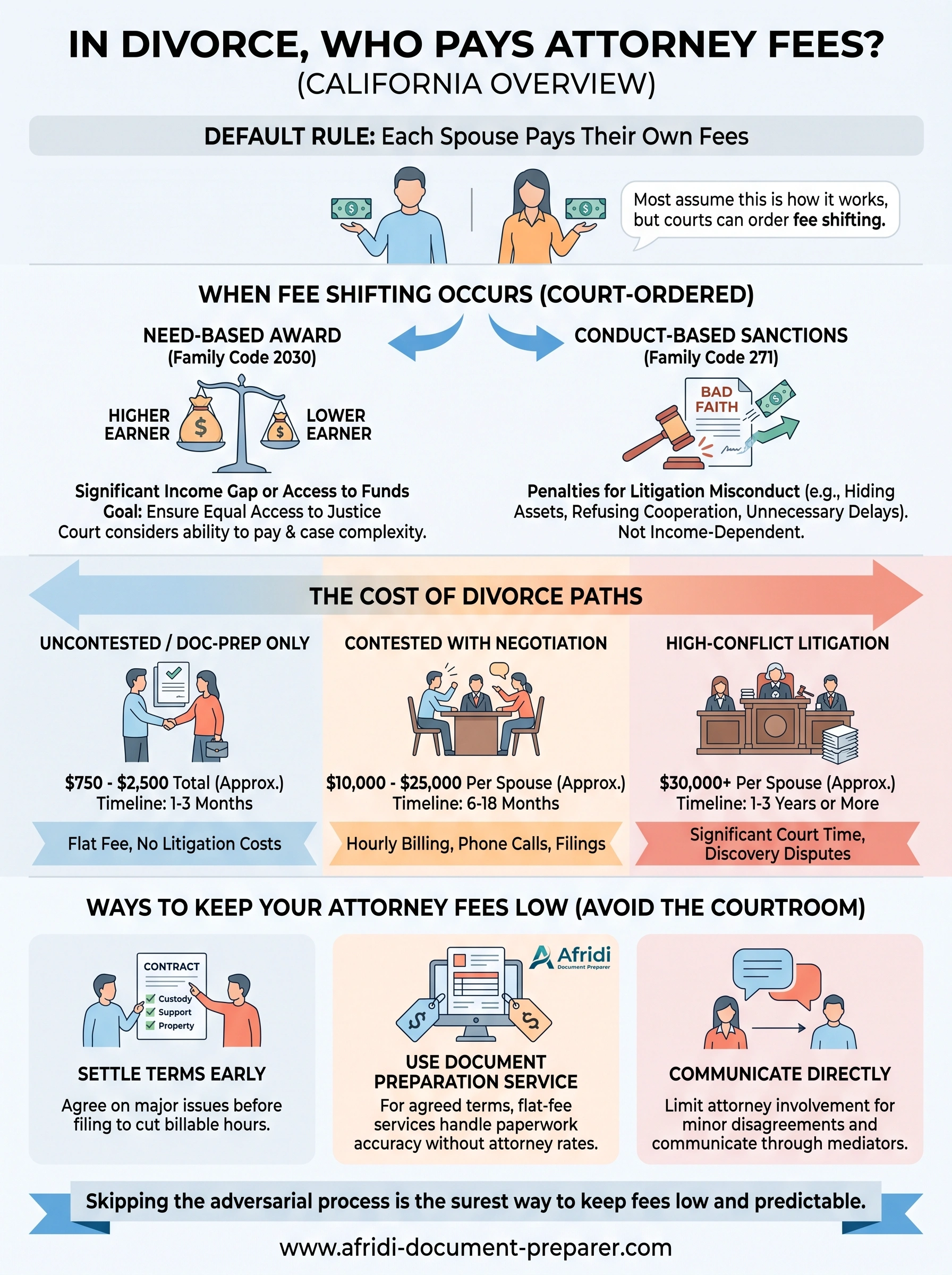
In California, the default rule is that each spouse pays their own attorney fees, but judges have the authority to order fee shifting when there's a significant income gap or when one party's conduct drags out the case unnecessarily. Courts look at factors like each spouse's ability to pay and whether one side is acting in bad faith, and they can order the higher-earning spouse to cover part or all of the other's costs through a need-based fee award.
That said, the surest way to keep fees low and predictable is to avoid the courtroom fight altogether. Below, we break down how fee allocation typically works, when you might qualify for a fee order, and how an uncontested divorce in California with a document preparation service can sidestep the issue entirely by keeping attorney costs out of the equation from the start.
Why it matters who pays your divorce attorney fees
Money drives more divorce conflict than almost anything else, and legal fees sit right at the center of that fight. A contested California divorce can run anywhere from $15,000 to $30,000 per spouse in divorce lawyer costs, according to data cited by the California Courts self-help resources. When you're already splitting a household, dividing retirement accounts, and figuring out custody, adding a five-figure legal bill to the mix can determine whether you come out of the marriage financially stable or buried in debt.

The spouse who controls the money often controls the case, unless the court steps in to level the field.
The real cost of a contested divorce
Understanding where the money actually goes helps explain why fee allocation becomes such a flashpoint. Attorneys typically bill hourly, and every phone call, court filing, and hearing adds up fast, especially once discovery disputes or custody evaluations enter the picture, so it helps to know the hourly rates divorce attorneys charge.
| Divorce Type | Typical Attorney Fees | Timeline |
|---|---|---|
| Uncontested/document-prep only | $750-$2,500 total | 1-3 months |
| Contested with negotiation | $10,000-$25,000 per spouse | 6-18 months |
| High-conflict litigation | $30,000+ per spouse | 1-3 years or more |
How fee disputes drag out the process
Once one spouse realizes the other can't easily fund a long fight, the case dynamics shift. A spouse with deeper pockets can sometimes use the cost of litigation as leverage, dragging out proceedings to pressure the other side into an unfavorable settlement. This is exactly the scenario California's fee-shifting statutes exist to prevent, and it's why judges pay close attention to income disparity when a fee motion lands on their desk.
The power imbalance issue
Without some mechanism for fee reimbursement, a lower-earning spouse, often someone who stepped back from a career to raise kids or support a partner's business, could be forced to accept a bad deal simply because they can't afford to keep fighting for a fair one. This access-to-justice problem is a big part of why California law gives courts discretion to order one spouse to help cover the other's legal costs. It's also why so many people in amicable situations choose a different path entirely: skipping the adversarial process, and the fees that come with it, by working through the terms together and using a document preparation service to file the paperwork correctly the first time.
How California courts decide who pays legal fees
Judges don't just guess when deciding who is responsible for attorney fees in a divorce. California Family Code Section 2030 gives courts a specific framework: they compare each spouse's income, assets, and access to funds, then decide whether one side needs help paying for representation so both parties can litigate on roughly equal footing. This isn't about punishing the wealthier spouse. It's about making sure a stay-at-home parent or lower earner isn't forced to accept an unfair settlement just because they can't hire a lawyer.
Fee orders exist to level the playing field, not to reward or penalize either spouse for how much they earn.
The Family Code 2030 factors
Courts weighing a need-based fee award typically look at:
- Each spouse's income and separate property
- Access to community funds during the case
- The complexity of the issues in dispute
- Whether one spouse already has a retained attorney and the other doesn't
- The overall disparity in ability to pay for representation
Gathering this financial picture usually happens through an Income and Expense Declaration filed with the court, and since accurate paperwork matters as much as the argument itself, it pays to understand the step-by-step process for filing a California divorce.
When bad behavior triggers a fee order
Separately, Family Code Section 271 lets judges penalize a spouse for litigation misconduct, like refusing to cooperate, hiding assets, or filing unnecessary motions just to run up the other side's bill. Sanctions under this section aren't tied to income at all. Even a wealthier spouse can be ordered to pay the other's fees if a judge finds their behavior obstructed the case or frustrated settlement. Together, these two legal paths, need-based awards and conduct-based sanctions, cover most of the situations where a California court shifts costs away from the default rule that each spouse pays their own way.
How to request fee reimbursement during your divorce
Requesting fee reimbursement isn't automatic. You have to ask the court formally, usually early in the case, through a document called a Request for Order (RFO). This motion asks the judge to review both spouses' finances and issue a temporary order requiring one side to contribute to the other's legal costs while the case is still pending, sometimes called "pendente lite" fees.
A fee order won't happen unless you actually file for one, waiting and hoping rarely works in family court.
Filing a Request for Order
Timing matters here. Filing early, ideally right after the initial petition and response, gives you access to funds before the bulk of the litigation costs pile up. Your attorney or, if you're representing yourself, the court's self-help center can guide you through completing form FL-300, which formally requests the fee award and outlines the specific relief you're seeking from the judge.
Documentation you need to build your case
Judges won't grant a need-based fee award on your word alone. You need to show your financial reality clearly, so gather the following before you file:
- Income and Expense Declaration (form FL-150)
- Recent pay stubs or proof of self-employment income
- Bank and retirement account statements
- A breakdown of attorney fees already incurred and expected
- Evidence of your spouse's income and assets, if accessible
What happens after you file
Once filed, the court schedules a hearing where both sides present their financial documentation. If the judge finds a real disparity in ability to pay, they'll issue an order, sometimes for a lump sum, sometimes for ongoing monthly contributions toward your legal bill. None of this applies, though, if both spouses agree on terms from the start, which is exactly why so many couples skip the motion practice altogether and prepare their paperwork through a flat-fee service instead.
Common scenarios that determine fee responsibility
Real cases rarely fit neatly into a single legal category, but a few patterns show up again and again when judges decide who pays attorney fees in a divorce. Knowing which bucket your situation falls into can help you predict whether a fee motion is worth filing or whether you're better off negotiating directly.

Income gap between spouses
Understanding the most common trigger starts with income. When one spouse earns significantly more, or controls most of the community assets, courts frequently step in under Family Code 2030 to fund the lower earner's representation. This shows up often in marriages where one partner left the workforce for childcare or supported the other's business without a formal salary.
Bad-faith conduct during litigation
Judges also shift fees when one spouse's behavior, not their income, causes the problem. Hiding assets, ignoring discovery requests, or filing repetitive motions to run up costs can trigger sanctions under Family Code 271, regardless of who earns more.
Bad behavior in court can cost you money even if you're the wealthier spouse.
Amicable and uncontested cases
Meanwhile, couples splitting up on amicable terms rarely deal with fee disputes at all, since there's no adversarial process generating the costs in the first place.
| Scenario | Typical Outcome |
|---|---|
| Large income disparity | Higher earner may be ordered to contribute |
| Hidden assets or stalling tactics | Sanctions under Family Code 271 |
| Mutual agreement on terms | No fee order needed |
| Uncontested divorce with document prep | Flat fee, no litigation costs |
Working through a flat-fee uncontested divorce in California sidesteps most of these scenarios entirely, since there's no ongoing litigation generating fees to fight over.
Ways to keep your divorce attorney fees low
Regardless of whether you'd win a fee motion, the smartest move is avoiding the need for one in the first place. Cutting the cost of ending a marriage starts long before you ever set foot in a courtroom, and most of the strategies below apply whether your case is amicable or already showing signs of friction.
The cheapest attorney fee is the one you never have to pay because there was nothing left to litigate.
Settle terms before you file
Couples who negotiate custody, support, and property division on their own, even with a mediator, cut out most of the billable hours that drive up costs. Try to lock down these basics before filing:
- Division of major assets and debts
- A parenting plan, if children are involved
- Spousal support terms, if any apply
- Who stays in the family home
Each point you agree on ahead of time is one less thing an attorney has to argue over later.
Use a document preparation service instead of an attorney
For spouses who already agree on the terms, hiring an attorney to draft paperwork you could file yourselves adds cost without adding value, which is why many choose divorce document preparation without an attorney. A flat-fee divorce document preparation service handles the Judicial Council forms, filing logistics, and paperwork accuracy for a fraction of attorney rates, since there's no hourly billing or courtroom time involved. Afridi Document Preparer's divorce and separation services start at $750 plus court fees for uncontested cases, which is often less than a single hour of litigation with a family law attorney, and well under the 2026 cost of an uncontested divorce handled other ways.
Communicate directly and limit disputes
Finally, every email, phone call, and disagreement routed through attorneys costs money on both sides. Spouses who communicate directly, even briefly through a mediator, avoid racking up fees over issues that could be settled with a conversation.
What this means for your divorce
So when someone asks in divorce who pays attorney fees, the honest answer is: it depends on income disparity, conduct during litigation, and whether you fight at all. California courts can order fee shifting under Family Code 2030 or 271, but qualifying for that relief still means months of motions, hearings, and stress. Skipping the fight entirely is almost always the better outcome.
Agreeing on terms with your spouse and filing accurate paperwork from the start keeps the whole question moot. There's no fee dispute to win when there's no litigation generating fees in the first place. That's the path most cost-conscious, uncontested couples in California end up choosing once they understand the alternative.
If you and your spouse are on the same page about how to split things, don't let attorney fees become the reason you aren't. Talk to Afridi Document Preparer about flat-fee uncontested divorce document preparation in Orange County and keep more of what you've earned.
Disclosure: The information provided in this article is for general informational purposes only and does not constitute legal advice. The author is not a licensed attorney. The content should not be construed as professional legal advice or a substitute for professional legal counsel. No attorney-client relationship is formed by reading or interacting with this article. The information presented may not reflect the most current legal developments, and laws and regulations can vary by jurisdiction and may change over time. Readers should not act or refrain from acting based on the information in this article without first seeking appropriate legal or other professional advice. Always consult a qualified attorney for advice regarding your specific legal matter or circumstances. The author expressly disclaims all liability in respect of actions taken or not taken based on any or all of the contents of this article.
