- 3001 Red Hill Ave Building 6 Suite 210, Costa Mesa, CA 92626
- info@afridi-document-preparer.com
- Book Appointment


How to Find a Good Living Trust Attorney
Searching for how to find a good living trust attorney usually starts after a scary Google search about what probate actually involves in California or a friend's estate that took two years to settle. You know you need a trust, but every attorney's website looks the same, and hourly rates in California can run $300 to $600 with no clear total cost upfront. That gap between wanting protection for your family and not knowing who to trust with the paperwork is exactly where most people get stuck.
The short answer: you vet an estate planning attorney the same way you'd vet a surgeon. Check their state bar standing, ask how many trusts they've drafted this year, and get a flat fee in writing before signing anything. Red flags include vague pricing, pressure to add unnecessary trust products, and attorneys who won't explain the plan in plain English.
This guide walks through where to search, the exact questions to ask during a consultation, and the warning signs that mean you should walk away. We'll also cover when a straightforward trust doesn't actually require attorney-level fees at all, including what a revocable living trust does and why a bonded, non-attorney document preparer like Afridi Document Preparer can often complete the same package for a fraction of the cost.
What to know before you start your search
Before you type "estate planning attorney near me" into Google, spend fifteen minutes figuring out what you're actually shopping for. Not every trust situation needs the same level of legal firepower, and knowing your own complexity level saves you from either overpaying an attorney for a simple job or underpaying a preparer for a job that genuinely needs legal advice.

Decide if your situation is actually complex enough to need one
Ask yourself a few blunt questions first. Do you own a business, have a blended family with kids from more than one marriage, hold property in more than one state, or have a beneficiary with special needs or a disability? Any yes answer means you likely need a licensed estate planning attorney who can address tax exposure, guardianship nuances, or multi-state property law. If your answer is no across the board, meaning you're married once, own a home in California, and want your assets to pass to your kids without probate, your situation is what attorneys themselves call "vanilla."
Most straightforward, single-family estates don't need attorney-level complexity, they need accurate paperwork.
That distinction matters because it changes where you should even be looking. A complex estate justifies the $2,500 to $5,000 an attorney typically charges for a full trust package. A simple one often doesn't.
Know the difference between an attorney, a paralegal, and a document preparer
California recognizes several tiers of help, and confusing them is the number one mistake people make when researching how to choose a living trust attorney. An attorney can give legal advice, represent you in disputes, and handle complicated tax or asset-protection strategy. A Legal Document Assistant (LDA) in California, which is what a company like Afridi Document Preparer is, cannot give legal advice but is bonded, registered with the county, and legally allowed to prepare standard legal documents at your direction, including a full revocable living trust package with the trust, pour-over will, power of attorney, and healthcare directive. Paralegals, by contrast, only work under an attorney's supervision and can't sell services directly to the public in California.
Set a realistic budget range before you call anyone
Having a number in mind before your first phone call keeps you from getting talked into services you don't need. Here's a rough breakdown of what each option typically costs in California:
| Option | Typical Cost | Best For |
|---|---|---|
| Attorney, hourly billing | $300-$600/hour | Complex, contested, or high-net-worth estates |
| Attorney, flat-fee trust package | $1,500-$3,500 | Moderate complexity, want attorney oversight |
| Legal Document Assistant (LDA) | $1,000-$1,500 flat | Straightforward, uncontested trust and will planning |
| Online DIY template | $100-$300 | Very simple estates, high risk of errors |
Rounding out your prep, gather the basics before you start reaching out: a rough list of your assets, current beneficiary designations, names of who you'd want as trustee and successor trustee, any special circumstances like a special needs child or out-of-state property, and a look at the key California estate planning forms you'll likely end up signing. Showing up organized signals to any attorney or preparer that you're a serious client, and it also helps you get an accurate quote on the first call instead of a vague "it depends" answer that wastes everyone's time.
Step 1. Determine what type of attorney you actually need
Not all estate planning attorneys practice the same way, and picking the wrong specialty wastes your consultation time, which is why it helps to know how to choose a revocable trust attorney before you start dialing. Some attorneys focus purely on trust drafting, others handle probate litigation, and a smaller group specializes in elder law or special needs planning. Walking into a general practice firm with a complex Medicaid planning question, or calling an elder law specialist for a simple single-family trust, both lead to mismatched expectations and higher bills than necessary.
Match the attorney's specialty to your actual need
Use this quick breakdown to narrow your search before you make a single phone call:
- General estate planning attorney: handles standard revocable trusts, wills, and powers of attorney for typical families
- Elder law attorney: focuses on Medi-Cal planning, long-term care, and asset protection for aging clients
- Special needs planning attorney: structures trusts that preserve a beneficiary's eligibility for government benefits
- Tax attorney or CPA-attorney: needed if your estate exceeds federal exemption thresholds or includes complex business holdings
- Probate litigator: only relevant if you're contesting a trust or will, not for initial planning
The right specialist for your situation is the one whose daily caseload looks like your problem, not the one with the best website.
Confirm whether you even need a courtroom lawyer at all
Here's where a lot of Californians overspend. If your goal is simply to avoid probate on a paid-off home and a couple of investment accounts, with no disputes, no special needs beneficiaries, and no business succession questions, you're describing a document preparation job, not a litigation risk. A licensed attorney brings value when there's judgment to exercise: interpreting ambiguous tax law, weighing guardianship options, or negotiating between disagreeing heirs. When none of that applies, a bonded California Legal Document Assistant can prepare the same trust documents at a fraction of the cost, which is exactly the gap local trust preparation options like Afridi Document Preparer's living trust package are built to fill.
Writing down your answer to this question before you search saves you from the single biggest time-waster in the whole process: booking consultations with attorneys who aren't a fit for your estate. Spend ten minutes now, and you'll walk into Step 2 already knowing whether you're building a shortlist of estate attorneys, specialists, or a qualified document preparer instead.
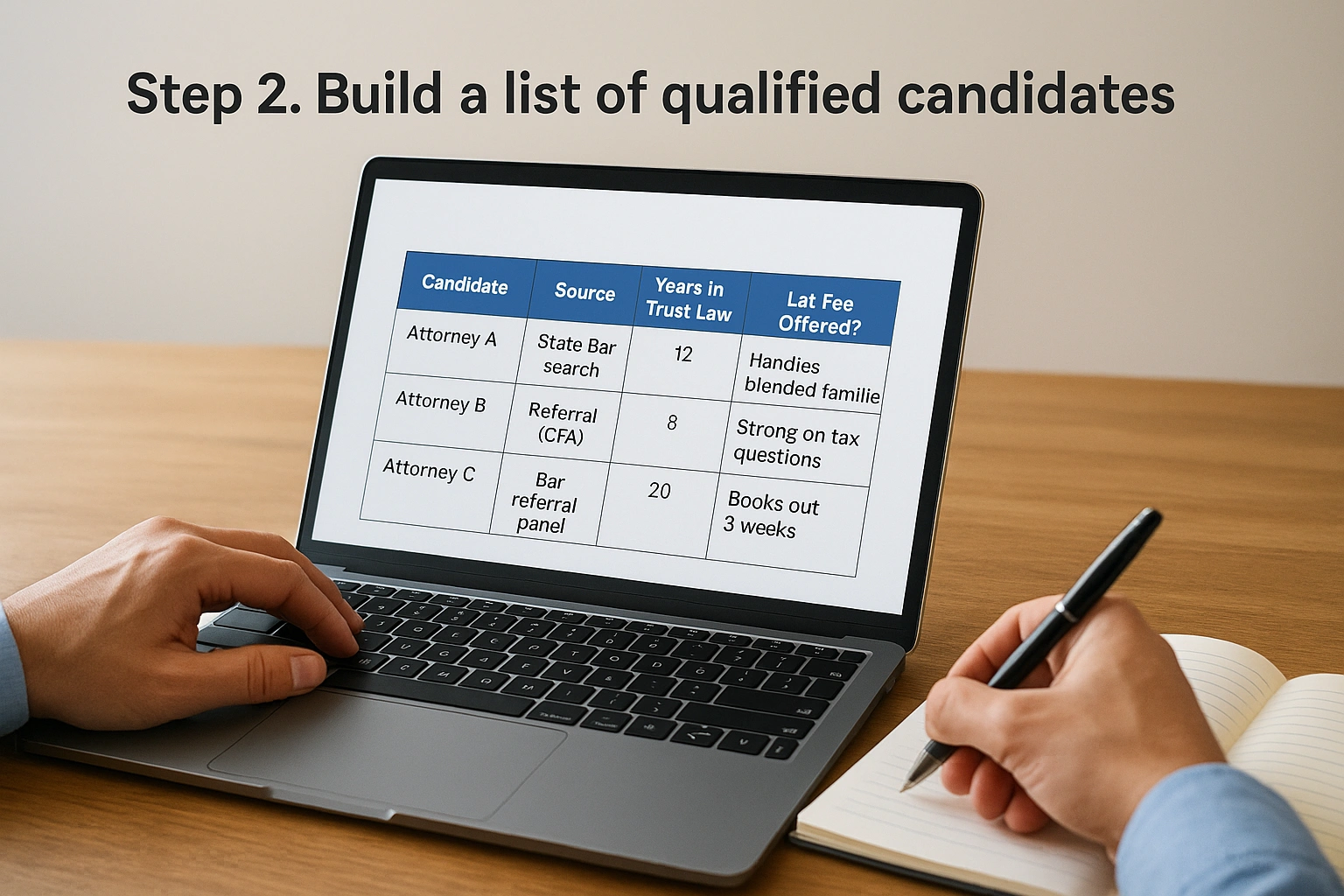
Step 2. Build a list of qualified candidates
Once you know what kind of help you need, start building a shortlist of five to seven names before you narrow it down, using the same approach you'd take to find the best living trust attorney near you. Casting a wide net early means you're comparing real options later instead of settling for the first attorney who answers the phone. This is also the stage where searching for a living trust lawyer near me actually pays off, since local knowledge of your county's probate court and recording office speeds up filing later.
Pull names from sources that actually vet attorneys
Skip the generic Google ads at the top of the search results. Those are paid placements, not endorsements of skill. Instead, pull candidates from sources that apply some kind of screening:
- State Bar of California's attorney search tool, which confirms active license status before you even call
- Local bar association referral panels, which typically require attorneys to carry malpractice insurance and meet minimum experience thresholds
- Personal referrals from a CPA, financial advisor, or friend who actually used the attorney for a trust, not just a will
- Estate planning specialist directories run by professional groups focused specifically on trust and probate law
A referral from someone who paid the bill and lived with the result beats any five-star review you find online.
Do a five-minute pass before you call anyone
Before you pick up the phone, spend five minutes on each candidate's website checking three things: how long they've practiced, whether trusts and estates make up the bulk of their caseload, and whether they publish any client testimonials or case results. Attorneys who bury their specialty under a dozen unrelated practice areas, like personal injury and criminal defense mixed with estate planning, usually aren't spending enough hours on trust law to stay sharp on the details that matter, like funding a trust correctly or avoiding a Medi-Cal estate recovery claim.
Compare your list side by side
Organizing what you find in a simple table keeps you from losing track once you've made a few calls:
| Candidate | Source | Years in Trust Law | Flat Fee Offered? | Notes |
|---|---|---|---|---|
| Attorney A | State Bar search | 12 | Yes | Handles blended families |
| Attorney B | Referral (CPA) | 8 | No, hourly only | Strong on tax questions |
| Attorney C | Bar referral panel | 20 | Yes | Books out 3 weeks |
Once you've got three to five names with basic notes filled in, you're ready to dig into credentials, which is where a lot of impressive-sounding websites fall apart under scrutiny.
Step 3. Verify credentials and specialization
Now that you have three to five names, stop trusting website copy and start verifying facts. A polished homepage tells you nothing about whether an attorney is in good standing or has ever actually drafted a trust that held up under scrutiny. This step takes maybe twenty minutes per candidate, and it's the single fastest way to eliminate anyone who looks better on paper than they perform in practice.
Confirm bar status and disciplinary history
Go straight to the source instead of relying on a firm's own claims. The State Bar of California publishes a free attorney search that shows license status, admission date, and any public discipline on record. Run every name on your shortlist through it before you schedule a single consultation.
- Confirm the license is active, not suspended, resigned, or on inactive status
- Check for any public record of discipline, probation, or client complaints
- Note the admission date, since a decade or more in practice usually means they've handled a real volume of trusts
If an attorney's own bio doesn't match what the State Bar record shows, that mismatch alone should end the conversation.
Look for real trust and estate specialization
Specialization matters more than years in practice alone. Ask directly whether the attorney holds a Certified Specialist in Estate Planning, Trust and Probate Law designation from the California Board of Legal Specialization, since that credential requires passing a dedicated exam and logging a minimum number of trust and probate cases. Attorneys without the certification can still be excellent, but you should ask what percentage of their caseload is estate planning versus other practice areas. Anything under 50 percent is worth a second look.
Ask about actual trust volume, not just years practicing
Experience on paper doesn't always translate to current skill. A qualified trust attorney should be able to tell you, without checking notes, roughly how many revocable living trusts they've drafted in the past twelve months, and whether they handle the funding process themselves or leave clients to retitle assets on their own. That second detail matters a lot, since an unfunded trust provides zero protection from probate no matter how well the document itself is written.
Step 4. Check reviews and professional reputation
Credentials tell you an attorney is legally qualified. Reviews tell you what actually happens once you're a client. Both matter, but reputation research catches problems the State Bar's clean record won't show, like an attorney who's technically in good standing but returns calls three weeks late or nickel-and-dimes every follow-up question.

Read reviews with a critical eye, not a skimming one
Google Business reviews and Yelp are a start, but don't stop at the star rating. Look for specific mentions of trust work, not just general praise about a friendly office. A review that says "handled our trust in six weeks and explained every document" tells you far more than one that just says "great lawyer, highly recommend." Pay attention to how the attorney responds to negative reviews too. A defensive or dismissive reply to a client complaint is a preview of how they'll treat you if something goes wrong later.
A five-star average built on three vague reviews tells you less than a 4.6 average built on forty detailed ones.
Check for disciplinary complaints beyond the State Bar
The State Bar search you ran in Step 3 covers formal discipline, but it won't catch informal complaints filed with consumer protection groups. Run each candidate's name through these sources as well:
- Better Business Bureau (BBB) profile, checking both the letter grade and any unresolved complaints
- Avvo or Martindale-Hubbell attorney ratings, which include peer endorsements from other lawyers
- Local Facebook groups or Nextdoor threads for your county, where neighbors sometimes share honest experiences that never make it onto formal review sites
Weigh long-term reputation over short-term marketing
Someone who's held a strong BBB rating for over a decade, the way Afridi Document Preparer has maintained an A+ rating for 15 years, has survived enough client interactions to prove the reputation is earned rather than manufactured through a recent review campaign. Newer firms with a sudden burst of five-star reviews in the last two months deserve extra scrutiny, since that pattern sometimes signals incentivized or fake reviews rather than organic client satisfaction.
Once you've cross-checked reviews against the credential work from Step 3, you should have a shortlist of two or three names that hold up from both angles: technically qualified and reputationally solid. That's exactly who you want sitting across from you at a consultation, which is the next step.
Step 5. Prepare for and conduct your consultations
Most estate planning attorneys offer a free or low-cost initial consultation, usually 30 to 45 minutes. Treat that window like a job interview where you're the one hiring. Walking in with a written list of questions keeps the conversation focused on your estate instead of letting the attorney control the pace and steer you toward add-on services you didn't come in looking for.
Bring the right documents and questions
Gathering paperwork ahead of time turns a vague conversation into a productive one. Pack a folder with your most recent property deed, a rough asset list, current beneficiary designations on retirement accounts, and names of your proposed trustee and successor trustee. Then bring a written list of questions so nerves don't make you forget the ones that matter most:
- How many revocable living trusts have you personally drafted in the last year?
- Do you handle the funding process, or is that left to me?
- What's included in your flat fee, and what triggers an hourly charge?
- How long does a typical uncontested trust take from signing to completion?
- Who in your office will actually be preparing my documents?
A consultation should leave you with a clear next step and a number in writing, not just a good feeling about the attorney.
Watch how they explain things, not just what they say
Paying attention to communication style matters as much as the answers themselves. A qualified estate attorney explains funding, probate avoidance, and trustee duties in plain language without leaning on jargon to sound impressive. If you leave the meeting more confused than when you arrived, that's a preview of every future phone call with that office, not a one-time fluke.
Compare notes across all your consultations before deciding
Scheduling all your consultations within the same one or two week window keeps the details fresh enough to compare fairly. Jot down a quick summary right after each meeting, including the quoted price, how rushed or unrushed the conversation felt, and whether the attorney answered your funding question directly. Doing this for finding a trust attorney the right way also naturally surfaces the same information you'd need if a document preparer route turns out to be the better fit, since Afridi Document Preparer's free phone consultation covers the same ground for straightforward trusts at no cost and no pressure to decide on the spot.
Step 6. Compare fee structures and get costs in writing
By the time you've sat through two or three consultations, you'll notice the quotes don't line up neatly. That's normal. Estate planning fees vary widely across California, and comparing them apples-to-apples means understanding the billing model before you compare the number itself. A $2,500 flat fee and a "$400 an hour, should take about six hours" estimate from another firm can land at the same total cost, or one can balloon well past the other once you factor in follow-up calls and document revisions.

Understand the three common fee models
Most attorneys bill one of three ways, and each shifts the risk differently between you and the firm:
- Flat fee: one price covers the full trust package, regardless of how many meetings or revisions it takes
- Hourly billing: you pay for actual time spent, which can run higher if your questions or edits pile up
- Hybrid: a flat fee for standard documents plus hourly charges for anything outside the original scope, like adding a second property later
Ask for the total out-the-door price, not just the hourly rate, since that's the only number that actually predicts your final bill.
Get everything in writing before you sign
A verbal quote means nothing once the invoices start arriving. Request a written fee agreement that spells out exactly what's included, what counts as an extra charge, and what happens if your situation turns out to be more complex than the attorney originally assumed. This single request, sent by email so you have a timestamp, resolves more billing disputes before they start than any conversation ever will.
Watch for hidden costs that inflate the final bill
Some of the biggest surprises come from services quietly billed outside the base fee. Ask specifically about notarization charges, recording fees for transferring your property deed into the trust, and whether funding assistance is included or billed separately. If an affordable living trust was your goal going in, these add-ons are exactly where an attorney quote can quietly climb past what a bonded document preparer charges for the same complete package, including notarization and deed recording, which is built into Afridi Document Preparer's flat $1,200 trust package from the start.
Step 7. Watch for red flags before you sign
Even after checking credentials, reading reviews, and sitting through consultations, some warning signs only show up right before you're ready to sign. Slowing down at this final stage catches the attorneys who look great on paper but pressure clients into decisions that don't serve them. Trust your gut here as much as your checklist, since most people who end up unhappy with an estate plan can point to a moment where something felt off and they signed anyway.
Notice pressure tactics and vague answers
Watch closely for language designed to rush you. An attorney who insists you need to sign "today" to lock in pricing, or who can't give you a straight answer about what's included in the fee, is showing you exactly how they'll operate for the life of your case. The same goes for pushy upselling, like insisting every client needs an irrevocable trust or asset protection add-on regardless of your actual situation. A trustworthy estate planning attorney explains why a recommendation fits your specific assets, not why it fits their revenue goals.
If you feel rushed to sign before you understand what you're buying, that's the clearest red flag of the entire search.
Spot warning signs in how they communicate
Pay attention to responsiveness during the sales process itself, since it rarely improves after you've paid. Attorneys who take a week to return a simple question during consultation, or who hand you off to a different staff member every time you call, are previewing how your case will actually be handled. Similarly, be wary of anyone who won't put fees in writing or who gets defensive when you ask for an itemized breakdown. Unclear billing practices at the consultation stage almost always turn into disputed invoices later.
Check the paperwork itself before signing anything
Before you sign an engagement letter, read every line. Confirm the document names the correct fee, spells out what happens if your case grows more complex, and includes a clear timeline for delivery. Watch for these specific red flags:
- No written fee agreement, only a verbal quote
- Vague language like "fees may vary" with no explanation of when or why
- Refusal to explain the funding process or who handles retitling your property
- Pressure to add trust products you didn't ask about during the consultation
- No clear point of contact if you have questions after signing
If two or more of these show up with a candidate you're seriously considering, go back to your shortlist rather than talking yourself into it.
Helpful directories and resources for your search
Gathering names from official sources beats scrolling through search ads, and a handful of directories do most of the vetting work for you before you ever pick up the phone. Bookmark these now, since you'll likely revisit them more than once as your shortlist changes throughout the process.
Government and bar association tools
Start with sources that carry regulatory weight rather than marketing budgets. The State Bar of California search tool confirms license status instantly, and your county's local bar association referral service typically screens for malpractice insurance and minimum years of practice before adding an attorney to its panel. The California Department of Consumer Affairs also publishes general guidance on hiring licensed professionals, which is worth a quick read if this is your first time working with any kind of legal service.
The best directory is the one that verifies something, not the one that ranks highest on Google.
Independent rating and review platforms
Once you've confirmed licensing, layer in independent reputation data. Avvo and Martindale-Hubbell both publish peer-reviewed attorney ratings that include endorsements from other lawyers, which catches professional respect that client reviews alone might miss. The Better Business Bureau rounds this out with a longer-term view, since a firm's letter grade and complaint history usually reflect years of client interactions rather than a recent marketing push.
| Resource | What It Verifies | Cost to Use |
|---|---|---|
| State Bar of California | License status, discipline | Free |
| Local bar referral panel | Insurance, experience minimum | Free |
| Avvo / Martindale-Hubbell | Peer ratings | Free |
| Better Business Bureau | Complaint history, grade | Free |
Where to look if the attorney route isn't the right fit
Somewhere in this research, plenty of Californians realize their estate is genuinely simple and that hiring an estate planning attorney for a straightforward revocable trust means paying for legal judgment they don't actually need. If that's your situation, a bonded Legal Document Assistant is worth adding to your comparison list alongside the other estate planning options available to Californians. Afridi Document Preparer's living trust package page lays out exactly what's included at a flat $1,200, and the free phone consultation available seven days a week gives you the same fact-finding conversation you'd get from an attorney intake call, minus the hourly clock running in the background.
Choosing the attorney who fits your situation
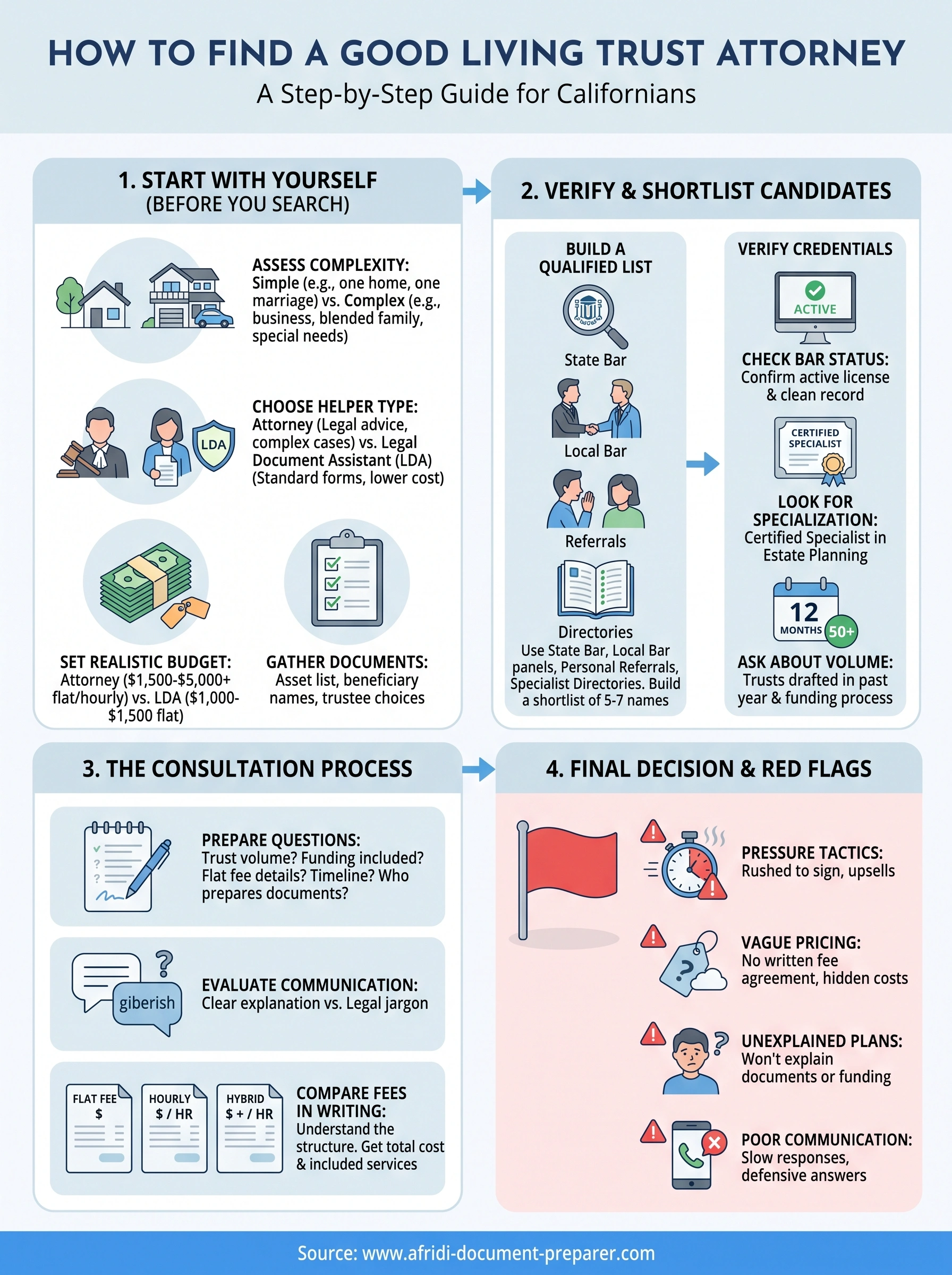
Finding a good living trust attorney comes down to a handful of habits: verify credentials through the State Bar of California, read reviews for specifics rather than star counts, and get every fee in writing before you sign anything. Skip any of these steps and you're gambling with paperwork that's supposed to protect your family, not add stress to it.
Remember that not every estate needs attorney-level firepower. If your situation is a single-family home, a couple of accounts, and no disputes on the horizon, you're paying for judgment you don't actually need. That's exactly the gap a bonded Legal Document Assistant fills at a fraction of the cost.
If that describes you, skip the hourly clock altogether. Book a free phone consultation with Afridi Document Preparer and find out if a flat-fee living trust package fits your situation better than an attorney would.
Disclosure: The information provided in this article is for general informational purposes only and does not constitute legal advice. The author is not a licensed attorney. The content should not be construed as professional legal advice or a substitute for professional legal counsel. No attorney-client relationship is formed by reading or interacting with this article. The information presented may not reflect the most current legal developments, and laws and regulations can vary by jurisdiction and may change over time. Readers should not act or refrain from acting based on the information in this article without first seeking appropriate legal or other professional advice. Always consult a qualified attorney for advice regarding your specific legal matter or circumstances. The author expressly disclaims all liability in respect of actions taken or not taken based on any or all of the contents of this article.
