- 3001 Red Hill Ave Building 6 Suite 210, Costa Mesa, CA 92626
- info@afridi-document-preparer.com
- Book Appointment

Do You Need Divorce Papers to Remarry in California?
You met someone new, or you're just ready to move forward, and now you're wondering do you need divorce papers to remarry in California before you can walk down the aisle again. It's a fair question, and county clerks won't just take your word for it that your last marriage is over. Marriage license offices require documentation, not a verbal promise.
The short answer is yes. You need your finalized divorce judgment, the actual court document showing your case is closed, not just the petition you filed or a court date you attended. Without it, a California county clerk will deny your marriage license application. There's also a timing issue most people overlook: California divorces aren't final the moment you appear in court, and that gap catches a lot of people off guard.
Below, we walk through exactly which document you need, how to get a copy if you've lost yours, how the six month waiting period affects your remarriage timeline, and what to do if your divorce is still pending but you're already planning ahead.
Why proof of your finalized divorce matters for remarriage
California treats marriage as a legal contract, and you can't enter a new one while an old one is still technically active. That's the entire reason clerks ask for your judgment of dissolution before handing over a new marriage license. They're not being difficult. They're following California Family Code requirements that protect against a situation called bigamy, which happens when someone marries a second person while still legally married to a first. Even an honest mistake, like assuming your court date finalized things, can trigger this problem if the paperwork doesn't back it up.
If your divorce judgment isn't filed and final, California law still considers you married to your ex, no matter how the split feels to you.
The gap between "divorced" and "legally divorced"
Here's where a lot of people get tripped up. You might feel done. You've split the assets, moved out, maybe even started dating again. But feeling divorced and being legally divorced are two different things in the eyes of a California county clerk. Your case isn't closed until a judge signs off and the court enters judgment, and even then, California imposes a mandatory six month waiting period from the date you served your spouse before the divorce can become final. Skip past that detail, and you could show up to apply for a new marriage license only to discover your old one is still active.
What clerks are actually protecting against
Without a certified divorce decree on file, the state has no way to confirm your prior marriage actually ended. That's a real problem for the integrity of marriage records, and it's why the requirement isn't optional or something a clerk can waive because you seem trustworthy. Consider what's at stake if the system didn't require proof:
- Marriage licenses could get issued to people who are still legally married elsewhere
- New spouses could unknowingly enter marriages with no legal standing
- Property, inheritance, and custody rights tied to the new marriage could later be challenged in court
- The state's vital records would become unreliable for legal and government purposes
Each of those outcomes is exactly why California treats remarriage documentation as a hard requirement rather than a formality.
Why this matters even if your split was amicable
Some people assume that because their divorce was uncontested or mutually agreed upon, the paperwork step is less important. It isn't. An uncontested divorce still has to go through the same court process, the same waiting period, and the same final judgment before it's recognized as complete. If anything, uncontested cases move faster precisely because both parties cooperate, which means the finalized document often arrives sooner than people expect. That's good news if you're eager to remarry, but only if you actually track down and keep the paperwork once it's issued.
Think of your divorce judgment the same way you'd think of a car title. You can drive the car, you can feel like it's yours, but until the title transfers, you don't legally own it. Your marital status works the same way. Until the judgment is entered and finalized, you're still legally tied to your previous marriage, and no county clerk in California will look past that when you apply for your next license.
How to confirm your divorce is legally final in California
Before you plan a new wedding date, verify your case status directly instead of relying on memory or an old court date. California courts post case information online through their local superior court portals, and most divorces filed after 2010 or so show up in these systems with a searchable case number. Look for two things: a judgment entered date and language confirming the dissolution is "final," not just "submitted" or "pending review."
A signed judgment sitting in a court file isn't the same as a finalized divorce. It has to be entered and dated before it counts.
Check the judgment date, not just the court hearing date
Many people confuse their court hearing with their finalization date, and that mix-up causes real problems, which is why it helps to see how a California divorce case moves from filing to judgment. Once a judge approves your judgment of dissolution, the court clerk still has to enter it into the record, and that entry date is what starts your legal single status, not the day you stood in front of a judge. Pull your paperwork and look for the actual entered date stamped by the clerk's office. If you can't find it, call the courthouse where you filed and ask them to confirm the entry date on record.
Confirm the six-month waiting period has actually passed
Separately, double check that your six month waiting period has fully run its course. This clock starts on the date your spouse was formally served, not the date you filed your petition, and not the date you attended a hearing. A quick way to confirm you're clear:
- Locate the proof of service filed with the court
- Add six months to that exact date
- Confirm today's date falls after that six month mark
- Cross-check that date against your judgment entry date, since both need to have passed
Questioning either date on your own is fine as a first step, but don't stop there. Requesting written confirmation from the court clerk removes any guesswork, and it gives you something concrete to bring with you when you apply for a new marriage license. Skipping this step is how people end up standing at the license counter with paperwork that looks final but technically isn't yet.
What counts as valid proof of divorce when applying for a license
County clerks in California don't accept just any piece of paper with "divorce" printed on it. They want a certified copy of your judgment, meaning an official copy stamped and issued directly by the superior court where your case was filed. A photocopy you made at home, a draft your document preparer sent for review, or the settlement agreement you and your ex signed months before finalization won't satisfy the requirement. The clerk needs something the court itself has verified as accurate and complete.
If the document doesn't carry a court seal and certification, it isn't proof of anything as far as a marriage license clerk is concerned.
Documents that qualify versus documents that don't
Here's a quick breakdown of what typically works and what gets rejected at the counter:
| Document | Accepted for remarriage? |
|---|---|
| Certified copy of Judgment of Dissolution | Yes |
| Notice of Entry of Judgment (with certification) | Usually, check with your county |
| Uncertified copy from your files | No |
| Marital Settlement Agreement alone | No |
| Petition for Dissolution (FL-100) | No |
| Divorce decree from another state (properly authenticated) | Yes, in most cases |
Out-of-state divorces add a wrinkle. If your prior marriage ended somewhere other than California, you'll typically need an authenticated decree from that state, sometimes with an apostille or exemplified copy depending on where it originated. California clerks are used to seeing these, but they'll still scrutinize the seal and signature closely.
Timing matters as much as the document itself
Just having a certified copy in hand isn't the whole story. Some counties also want the document to reflect that your six month waiting period has already elapsed before they'll issue a new license, so bring both the certified judgment and a way to confirm the entry date lines up. If your original paperwork was prepared through a California divorce paperwork service like ours at Afridi Document Preparer, we can help you track down the correct filing details so you're not guessing which document to request. Getting this piece right upfront saves you a second trip to the clerk's office and keeps your remarriage timeline on track.
What happens if you remarry without your finalized papers
Skipping the paperwork step doesn't just risk a denied application at the counter. If a clerk somehow issues you a license before your finalized divorce judgment exists, and you go through with the ceremony, California law treats that new marriage as void from the start. It's not a marriage that needs to be annulled later so much as one that never legally existed in the first place, because you were still married to your first spouse when you said "I do" the second time.
A wedding ceremony can't override an unfinished divorce. If the first marriage was still active, the second one legally never happened.
The bigamy problem nobody wants
Under California Penal Code Section 281, marrying someone while still legally married to another person is a criminal offense, and it applies even when the second marriage was entered in good faith. Prosecutions are rare when someone genuinely believed their divorce was final, but the civil consequences hit almost everyone who ends up in this situation:
- Your new marriage has no legal standing, meaning no spousal rights, no shared property protections, and no automatic inheritance rights
- Any children born during the invalid marriage may face complications establishing parental rights, though paternity can usually still be sorted out separately
- Health insurance, tax filing status, and Social Security spousal benefits tied to the new marriage can all be challenged or clawed back
- You'll likely need to formally annul the void marriage before you can remarry correctly, adding another court process to an already stressful situation
Fixing it after the fact
Untangling this mess almost always means going back to court twice: once to properly finalize the original divorce if it wasn't actually complete, and again to annul the invalid marriage before a new license can be issued correctly. Neither process is instant, and both add months to a timeline you were probably trying to shorten in the first place. Verifying your paperwork before the ceremony costs you almost nothing. Fixing it after costs time, money, and sometimes real heartbreak for the people involved.
How to get a certified copy of your divorce judgment
Losing track of your paperwork happens more than you'd think. Boxes get packed, addresses change, and years pass between the divorce and the moment you actually need the document again. Fortunately, getting a certified copy of your divorce judgment is a straightforward process once you know which courthouse to contact, and help with California divorce paperwork is available if the details are unclear.
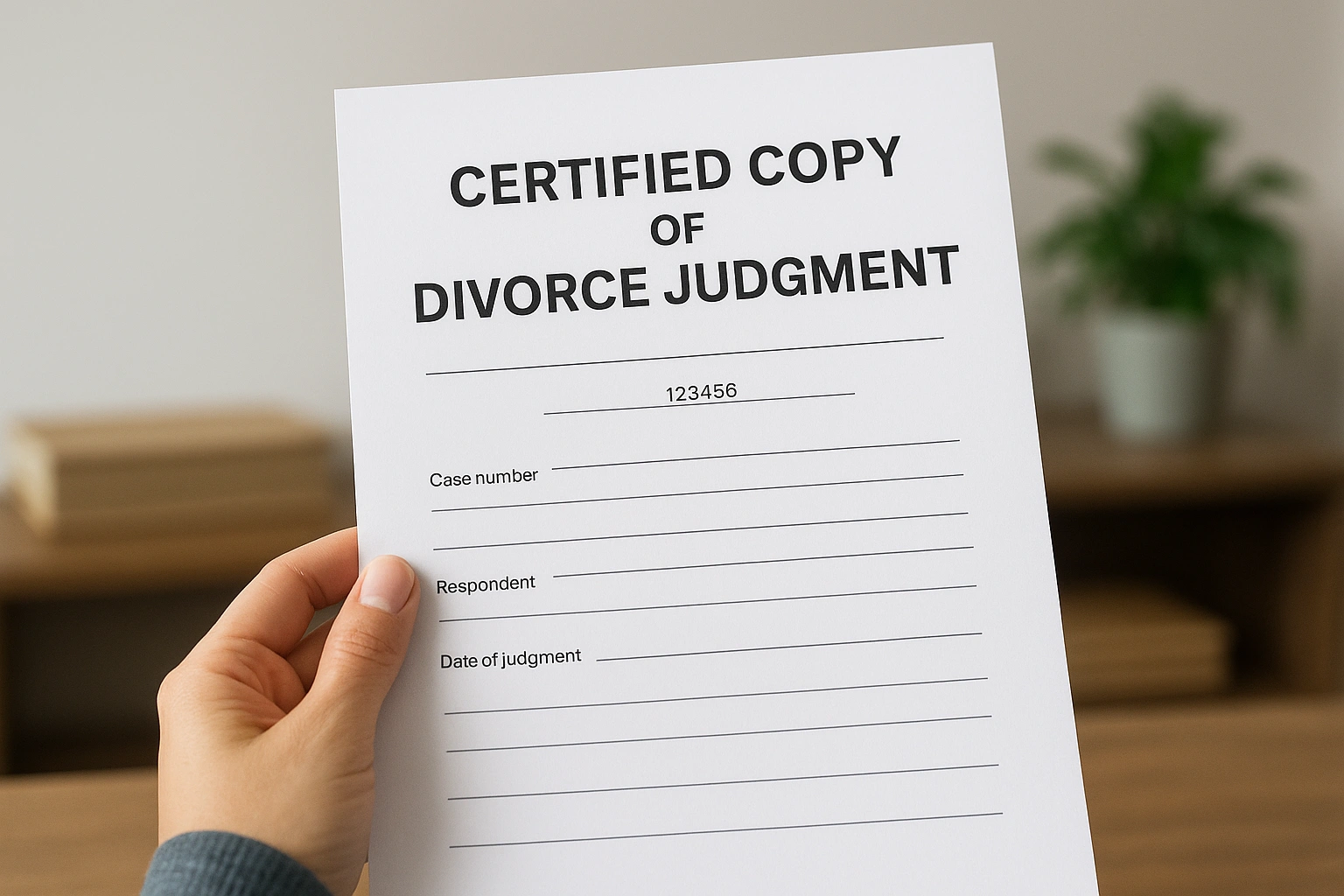
Your divorce file doesn't disappear. The superior court that granted your judgment keeps it on record indefinitely, and you can request a certified copy any time.
Requesting the copy from the superior court
Start with the superior court clerk's office in the county where your divorce was originally filed, not necessarily where you live now. Most California courts let you request certified copies in person, by mail, or through an online records request system, though availability varies by county. You'll typically need:
- Your case number, if you still have it
- Your full legal name and your ex-spouse's full legal name at the time of filing
- The approximate year the judgment was entered
- A government-issued photo ID
- A small per-copy fee, usually somewhere between $15 and $40 depending on the county
If you don't have your case number, the clerk can usually search by name, though it takes longer and sometimes requires a small additional search fee.
What if the case is old or the file was archived
Cases older than a few years sometimes get moved to offsite storage, which can stretch the wait from same-day service to a few weeks. Requesting your copy well before you plan to apply for a new marriage license gives you breathing room if the file needs to be pulled from archives. Mail requests generally take longer than in-person visits, so if your wedding date is approaching fast, a phone call to confirm processing time is worth the five minutes it takes.
When the original preparer can help
If your divorce paperwork was originally prepared through a service like Afridi Document Preparer, we can often help you pin down the exact case number, filing county, and judgment date, which speeds up your request considerably. That's especially useful if years have passed and the details are fuzzy. Having the right reference information on hand turns a request that could take weeks into one that takes days.
What to do if your divorce isn't final but you want to remarry sooner
Waiting is frustrating, especially once you've already decided you're ready for a new chapter. But there's no legal shortcut around California's mandatory waiting period, and it's worth knowing how long a California divorce actually takes from start to finish. The six months runs from the date your spouse was served, and no judge, clerk, or attorney can waive it, not even for military deployment, pregnancy, or a wedding venue you've already booked. If someone tells you they know a way to speed it up, they're wrong, and acting on that advice is exactly how people end up with a void marriage.
There's no expedited path around the six month rule in California. The calendar decides, not your circumstances.
Plan around the date, not against it
What you can control is timing everything else around your known finalization date. Once you confirm the date your spouse was served, you have a firm target to build toward. Practical steps that actually help:
- Confirm the service date and calculate your earliest possible judgment date
- Set your wedding date at least a few weeks after that mark, giving the court time to process paperwork
- Avoid booking vendors or venues for a date that falls before your judgment could realistically be entered
- Check in with your superior court clerk periodically as the date approaches, since processing backlogs happen
Consider getting engaged instead of married
An engagement carries no legal restrictions, so there's nothing stopping you from planning, ring shopping, or even sending save-the-dates for a date you know falls safely after your divorce is final. Some couples use the waiting period to plan a larger ceremony, since the extra months buy time for venues and guest logistics anyway. Others simply treat it as a firm deadline and get administratively married at the courthouse the moment the judgment clears, saving the bigger celebration for later.
If you're unsure whether your divorce case is tracking toward finalization on schedule, or you want help confirming your service date and projected judgment date, our team at Afridi Document Preparer can help you check your file and plan around it accurately.
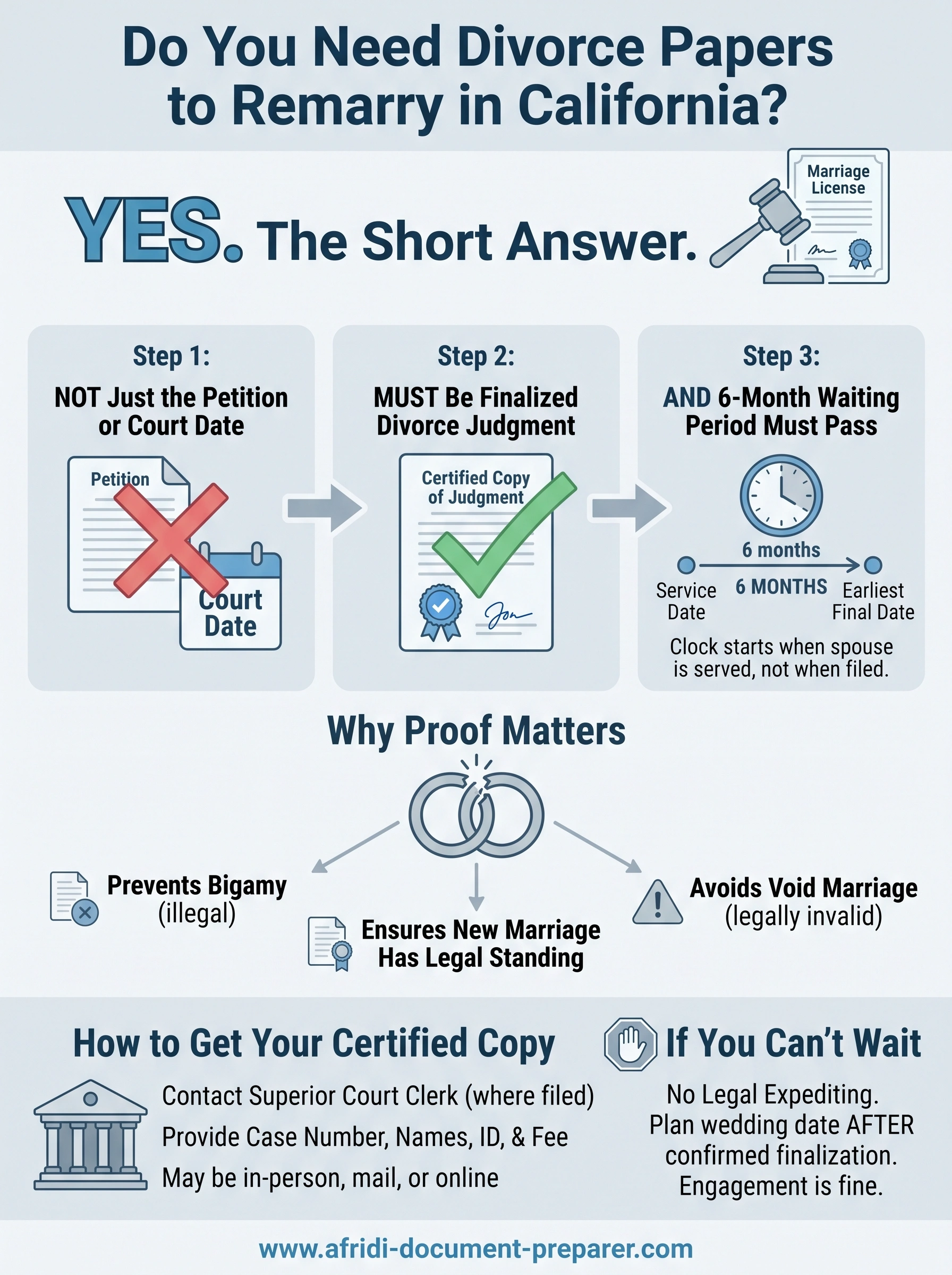
Getting ready for your next chapter
So yes, you need divorce papers to remarry in California, specifically a certified copy of your judgment, not just a settlement agreement or a memory of your court date. Confirm your judgment entry date, verify your six month waiting period has run, and request certified copies well before your wedding date approaches. Skipping any of these steps risks a void marriage, a denied license application, or a scramble at the courthouse counter when you least want one.
None of this has to be complicated once you know what the clerk actually needs to see. If your original divorce was handled somewhere else, or you're not sure your paperwork is truly final, don't guess your way through it. Reach out to Afridi Document Preparer for uncontested divorce document preparation in California, and we'll help you confirm your case status, track down your certified judgment, and get your timeline squared away before you set a new wedding date.
Disclosure: The information provided in this article is for general informational purposes only and does not constitute legal advice. The author is not a licensed attorney. The content should not be construed as professional legal advice or a substitute for professional legal counsel. No attorney-client relationship is formed by reading or interacting with this article. The information presented may not reflect the most current legal developments, and laws and regulations can vary by jurisdiction and may change over time. Readers should not act or refrain from acting based on the information in this article without first seeking appropriate legal or other professional advice. Always consult a qualified attorney for advice regarding your specific legal matter or circumstances. The author expressly disclaims all liability in respect of actions taken or not taken based on any or all of the contents of this article.
