- 3001 Red Hill Ave Building 6 Suite 210, Costa Mesa, CA 92626
- info@afridi-document-preparer.com
- Book Appointment

Disadvantages of Legal Separation in California: What to Know
You are weighing legal separation against divorce, and every article online seems to praise legal separation without mentioning its downsides. Before you file paperwork based on someone's Facebook advice, you need to understand the disadvantages of legal separation in California as clearly as the benefits, because this decision affects your finances, your health insurance, and your ability to remarry for years to come.
The short answer: legal separation keeps you legally married, which means you cannot remarry, you may still face complications with taxes and inheritance, and if your circumstances change, you will likely need to convert the case to a divorce anyway, adding time and cost. That said, the benefits of legal separation in California are real for specific situations, like preserving military or health benefits, or honoring religious beliefs against divorce.
In this article, we break down exactly what you give up and what you gain by choosing separation over dissolution, using real scenarios common among California couples. If you decide document preparation is the right next step, our team at Afridi Document Preparer handles the paperwork for both legal separation and divorce filings across all 58 California counties, so you can move forward with confidence once you know which path fits your situation.
Why the disadvantages of legal separation matter
Most people research legal separation because they assume it's a gentler, cheaper version of divorce. It isn't. Legal separation changes almost nothing about your legal marital status, and that single fact ripples into your finances, your future relationships, and your paperwork burden for years. Skipping this analysis before filing is how people end up paying for two legal processes instead of one, so understanding the real trade-offs upfront saves you money and frustration later.
You're still legally married in every sense
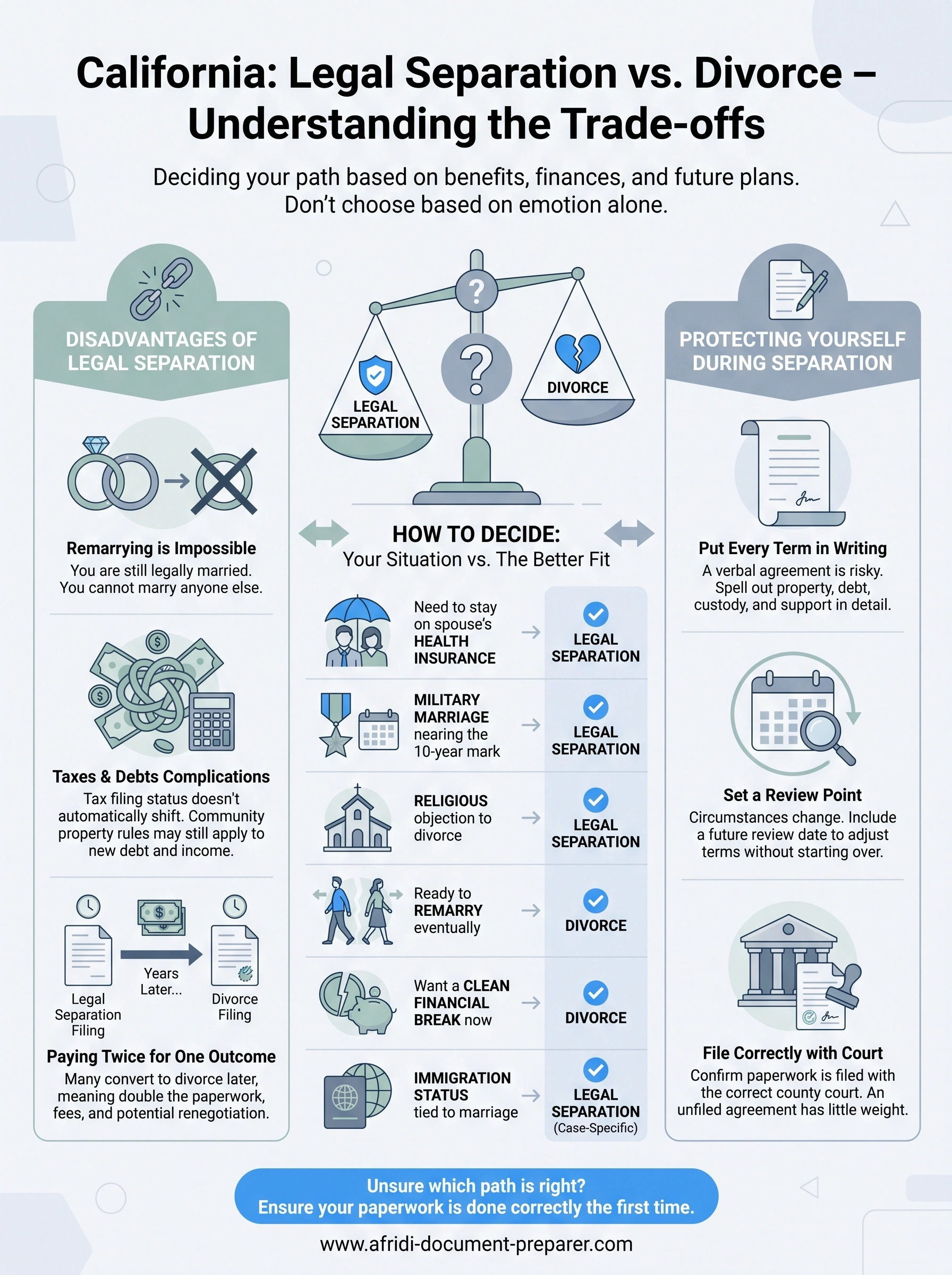
How legal separation works in California lets you live apart, divide property, and set custody terms, but your marriage certificate stays valid. You cannot remarry. You cannot file taxes as a single person. If your spouse racks up debt after separation in a way that touches community assets, you may still have exposure depending on how the agreement is drafted. Health insurance sometimes stays intact, which is the whole point for many people, but that benefit comes bundled with every other consequence of remaining married.
Legal separation ends the relationship without ending the marriage, and that gap is where most of the disadvantages live.
Taxes, debts, and inheritance don't stop
Remaining married means your tax filing status doesn't automatically shift, and community property rules in California keep applying to income and debt accumulated during the separation unless your agreement specifically addresses it. Inheritance rights also stay in place. If your spouse dies without a will while you're legally separated, you could still inherit under California's intestate succession laws, which surprises people who thought separation had already settled that question. None of this is disastrous, but it requires the same careful drafting a divorce settlement would need, so the cost savings people expect often don't materialize.
Paying twice for the same outcome
Here's the disadvantage that catches the most people off guard: many legally separated couples eventually convert to divorce anyway. When that happens, you're not just filing new forms. You're paying preparation fees a second time, refiling with the court, and sometimes renegotiating terms that already took months to settle the first time around. Couples who know from the start that they'll eventually want to remarry or fully sever ties are usually better served going straight to divorce, since legal separation only postpones that filing rather than replacing it.
Why some couples choose legal separation over divorce
Despite the drawbacks, thousands of Californians pick legal separation every year, and their reasons usually fall into a handful of predictable categories. Understanding these benefits of legal separation in California helps you see whether your situation actually matches one of them, or whether you're just avoiding the word "divorce" out of habit.
Religious and personal convictions
Some couples belong to faiths that discourage or forbid divorce outright, so legal separation offers a way to live apart and divide responsibilities without violating those beliefs. Others simply aren't ready to close the door on the marriage permanently, even after deciding they can't live together anymore. For these couples, the legal recognition of separation matters more than any tax or benefit calculation.
Keeping benefits and coverage intact
The most common practical reason is health insurance. Many spouses stay on a shared plan because divorce would trigger a loss of coverage they can't easily replace. Military families face a similar issue: staying married for ten years affects a former spouse's access to certain retirement and healthcare benefits under federal rules. Immigration status can factor in too, when one spouse's case depends on the marriage remaining legally valid.
The right reason to choose legal separation is a specific, provable benefit you'd lose by divorcing, not just hesitation about making it final.
If your situation matches one of these patterns, separation earns its cost. If it doesn't, you're likely paying for a delay rather than a solution.
How to decide between legal separation and divorce
Deciding whether legal separation is better than divorce comes down to one question: are you preserving a specific, identifiable benefit, or are you avoiding a decision you've already made emotionally? The key differences between separation and divorce aren't a matter of which is "nicer," they're a matter of which matches your actual circumstances. Run through your finances, your insurance situation, your military or immigration status, and your honest timeline for remarriage before you pick a lane.

If you can't name the specific benefit legal separation protects, you probably don't need it.
A quick comparison helps clarify which situation fits your case:
| Your Situation | Better Fit |
|---|---|
| Need to stay on spouse's health insurance | Legal separation |
| Military marriage nearing the 10-year mark | Legal separation |
| Religious objection to divorce | Legal separation |
| Ready to remarry eventually | Divorce |
| Want a clean financial break now | Divorce |
| Immigration status tied to the marriage | Legal separation (case-specific) |
Once you've matched your situation to a column, talk through the paperwork implications with someone who prepares these documents regularly, since the forms and timelines differ even though the underlying process feels similar. Separation agreements still need the same precision as a divorce settlement covering property, custody, and support, so don't assume the lighter-sounding option means lighter paperwork. Consider also whether your spouse agrees on the approach, since a contested separation can end up costing as much as a contested divorce with none of the finality.
How to protect yourself during a legal separation
Once you've chosen legal separation, the work shifts from deciding to drafting. A loose or verbal agreement leaves you exposed to the same disputes a divorce would create, just without the finality that forces resolution. Protecting yourself means treating the separation agreement with the same seriousness as a divorce settlement, even though you're staying married on paper.

Put every term in writing
Verbal understandings about who pays what or who keeps which asset fall apart the moment memories differ. Your separation agreement should spell out property division, debt responsibility, custody schedules, and how support payments are calculated and how long they last in the same detail a divorce judgment would require. Include a specific list of separate versus community property, since anything left vague becomes a fight later.
A separation agreement with gaps in it protects nobody, no matter how amicable the split feels today.
Set a review point and file it correctly
Circumstances change. Build a review date into the agreement, maybe annually, so you can adjust support or custody terms without starting from scratch. Also confirm the paperwork is filed with the correct county court, since an unfiled or improperly filed agreement carries little weight if a disagreement lands you in front of a judge, so review the step-by-step filing process for legal separation before you submit anything.
- Document every asset and debt with dates and values
- Address health insurance and tax filing status explicitly
- Set a review date for support and custody terms
- File the agreement with the appropriate county court
If drafting this yourself feels risky, our legal separation preparation service handles the forms so nothing gets left out.
Finding the right path forward
Weighing legal separation against divorce comes down to honesty about your situation. If you're protecting health coverage, military benefits, or a religious conviction, the disadvantages of legal separation are a fair trade for what you keep. If you're just avoiding the word "divorce," you're likely paying for a delay that ends in the same filing anyway. Either choice demands a carefully drafted agreement covering property, support, and custody, since a loose document protects nobody once circumstances shift.
You don't have to sort this out alone or guess at which Judicial Council forms apply to your case. Once you know whether separation or divorce fits your life, get the paperwork done right the first time. Start your filing with uncontested divorce and legal separation document preparation from Afridi Document Preparer and move forward with documents prepared correctly across all 58 California counties.
Disclosure: The information provided in this article is for general informational purposes only and does not constitute legal advice. The author is not a licensed attorney. The content should not be construed as professional legal advice or a substitute for professional legal counsel. No attorney-client relationship is formed by reading or interacting with this article. The information presented may not reflect the most current legal developments, and laws and regulations can vary by jurisdiction and may change over time. Readers should not act or refrain from acting based on the information in this article without first seeking appropriate legal or other professional advice. Always consult a qualified attorney for advice regarding your specific legal matter or circumstances. The author expressly disclaims all liability in respect of actions taken or not taken based on any or all of the contents of this article.
