- 3001 Red Hill Ave Building 6 Suite 210, Costa Mesa, CA 92626
- info@afridi-document-preparer.com
- Book Appointment


Can You Set Up a Living Trust without an Attorney?
You've priced out an estate planning attorney, seen what revocable living trust attorneys charge and what they actually do, and the quote made your eyes water. Now you're wondering: can you do a living trust without an attorney? The short answer is yes, California law doesn't require a lawyer to create one, and thousands of residents prepare their own trusts every year without a courtroom fight or a probate mess down the road.
What matters is doing it correctly. A living trust only works if it's drafted properly, funded with your actual assets, and signed and notarized the way California law requires. Skip a step, like forgetting to retitle your house into the trust, and your family could end up in probate anyway, which defeats the entire point. So can you set up a revocable trust without an attorney and still protect your estate? Absolutely, if you know which documents you actually need and where people typically go wrong.
This guide walks through how to create a living trust without an attorney in California, covering the core documents a complete package requires, the funding steps homeowners often miss, and when a document preparer can help you get everything right without paying attorney rates for a straightforward, uncontested estate plan.
What to know before setting up a living trust yourself
Before you sit down to draft anything, understand what a living trust actually is under California law: a legal arrangement where you transfer ownership of your assets into a trust you control while you're alive, then pass them to your beneficiaries without probate court involvement. California doesn't require attorney involvement to create one, but the state does require specific formalities: the trust must be in writing, you must have the legal capacity to create it, and it needs to be signed and notarized correctly. Miss any of these and a court can invalidate the whole document.
A living trust that isn't funded with your actual assets is just paperwork, not an estate plan.
Here's the part most people underestimate: drafting the trust document is only half the job. The other half is retitling your assets, house, bank accounts, vehicles, sometimes business interests, into the name of the trust. This is called funding, and it's the step attorneys charge the most for and DIY filers skip the most often. If you're wondering can I create a living trust without an attorney and have it actually work, funding is where the answer hinges.
The documents a complete package usually includes
A thorough revocable living trust isn't a single page. Most complete packages, whether drafted by an attorney or a document preparer, cover the six key California estate planning forms listed below:
- The Trust document itself, naming trustees and beneficiaries
- A Certification of Trust, which banks and title companies accept without disclosing full trust terms
- A Pour-Over Will, catching any assets you forgot to fund into the trust
- A Durable Power of Attorney, for financial decisions if you're incapacitated
- An Advance Healthcare Directive, for medical decisions
- A Final Arrangements document, spelling out your wishes
Where DIY filers most often stumble
Common mistakes include using outdated template language, forgetting successor trustee provisions, and, most costly, never recording the new deed after transferring real property. Property deed recording is a separate legal filing with the county recorder, and if you skip it, your house stays outside the trust no matter what the trust document says. If you'd rather have someone check this work, Afridi Document Preparer's revocable living trust package bundles all seven documents plus notarization and deed recording for a flat fee.
Step 1. Decide if a DIY living trust fits your situation
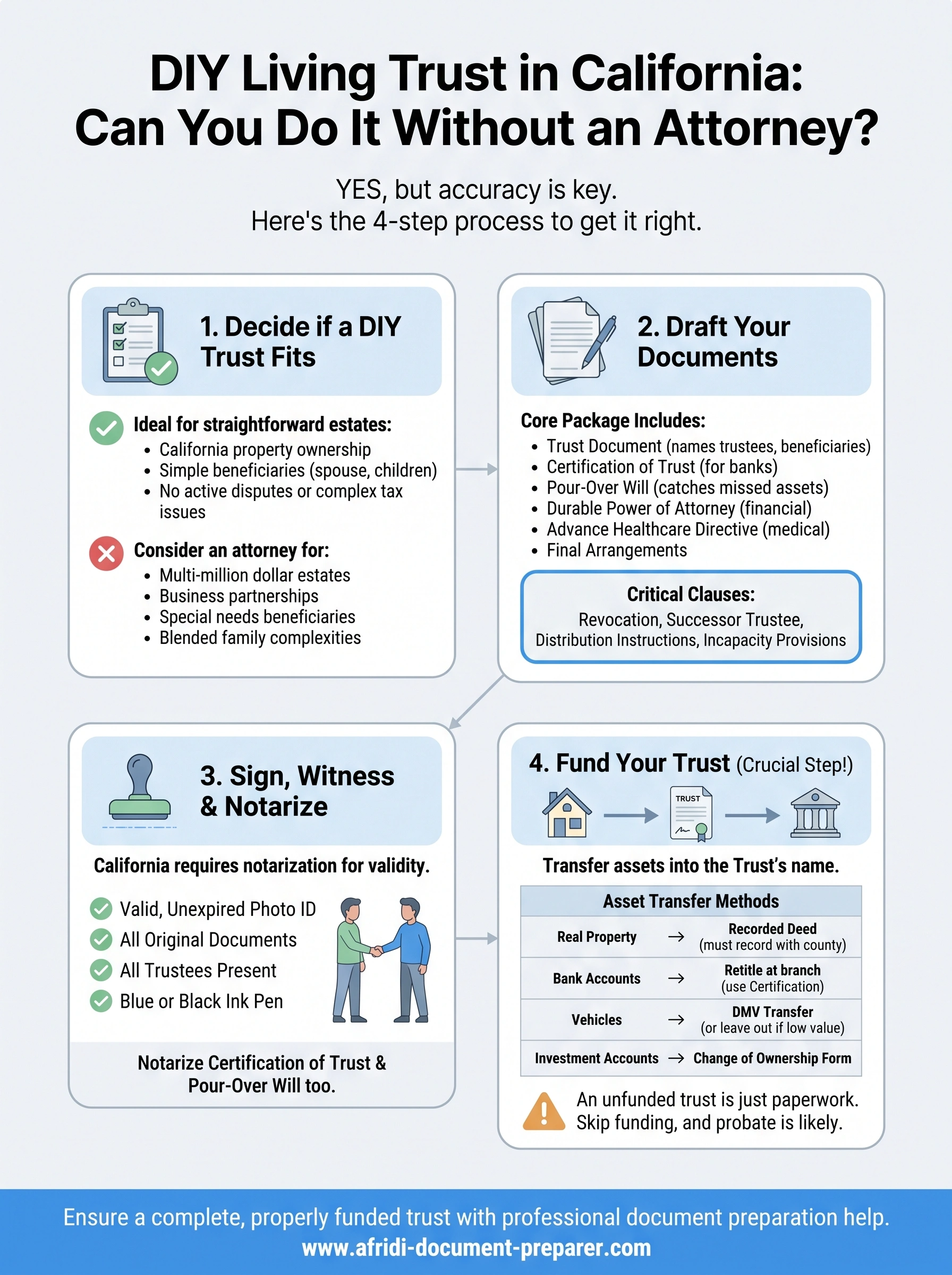
Start by being honest about the complexity of your estate and whether a living trust is necessary for your situation at all. A DIY living trust works well when your situation is straightforward: you own property in California, you have a clear list of beneficiaries, and you're not trying to solve for estate tax exposure, special needs beneficiaries, or blended-family disputes. If you're asking can you make a living trust without an attorney and your estate fits this description, the answer is a confident yes.
The simpler your estate, the less you need a lawyer and the more a DIY trust makes sense.
Watch for red flags that push you toward hiring an attorney instead. Estates worth several million dollars, business ownership with multiple partners, beneficiaries with disabilities who receive government benefits, or blended families where you want to favor children from a prior marriage all involve legal judgment calls that go beyond filling out a template. A document preparer can prepare the paperwork you direct them to prepare, but can't advise you on which strategy fits your family's tax or inheritance situation.
Quick self-check before you proceed
Run through this list before committing to the DIY route:
- Do you own California real estate and want to know the ways to keep a home out of probate court?
- Is your beneficiary list simple, spouse, children, or a short list of named people?
- Do you and your spouse (if married) agree on how assets should be divided?
- Are you free of active lawsuits, bankruptcy, or creditor disputes?
- Do you understand you'll need to retitle assets yourself after signing?
If you answered yes to all five, a self-prepared or document-preparer-assisted trust likely fits. If you hesitated on any of them, that's worth a conversation with an attorney first.
Step 2. Draft your living trust document
Once you've confirmed a DIY trust fits your situation, the actual drafting starts. This is where how to create a living trust without an attorney gets concrete: you need to name your trustee (usually yourself, while you're alive), name a successor trustee to take over when you die or become incapacitated, and list your beneficiaries with specific percentages or specific gifts. Vague language here causes most of the disputes that end up back in probate court, so be precise about names, relationships, and shares.
A trust document is only as strong as its weakest clause, so precision beats brevity every time.
The clauses you can't skip
Every California revocable trust needs a handful of provisions to hold up under scrutiny. Missing even one weakens the document:
- Revocation clause stating you can amend or cancel the trust while alive
- Successor trustee provisions naming at least two backups in order
- Distribution instructions specifying outright gifts versus staggered payouts
- Incapacity provisions defining how a trustee proves you can no longer manage your own affairs
- Schedule of assets listing what's being transferred into the trust
Templates versus professional drafting
Free templates exist online, and while it helps to see what a finished trust document actually looks like, most use generic language that doesn't reflect California's specific probate code requirements, and outdated versions circulate widely. If you're still asking can I do a living trust without an attorney and get language that actually protects your family, the safer route is a document preparer who uses California-compliant forms rather than a generic download. Afridi Document Preparer builds the trust, certification, and pour-over will together so the paperwork works as one coordinated package rather than three mismatched documents.
Step 3. Sign, witness, and notarize your trust
Once your draft is finalized, signing it correctly is what turns your document from a plan into a legally binding trust. California law requires your signature to be notarized, and while witnesses aren't strictly mandatory for a revocable living trust the way they are for a will, most document preparers include them anyway to strengthen the document against future challenges. Sign every page, not just the signature block, since an unsigned or missing page can give a probate court reason to question the trust's authenticity later.
Skip the notary and your trust is just a well-written draft, not a legal document.
California notarization requirements
Before you head to a notary, gather what you'll need. California notaries are strict about identification and won't proceed without proper documents:

- A valid, unexpired photo ID, such as a driver's license or passport
- Every original document requiring notarization, not photocopies
- All trustees present, since a notary can't notarize a signature for someone who isn't physically there
- A pen with blue or black ink, since some counties reject other colors on recorded documents
Handle the Certification of Trust and Pour-Over Will at the same appointment if possible, since banks and title companies will ask for a notarized Certification that meets the nine elements California requires under Probate Code 18100.5 before they'll retitle any account. Skipping this step is one reason people who ask can you set up a living trust without an attorney end up stuck later, their bank simply won't recognize an unnotarized document. Afridi Document Preparer includes notarization in its trust package specifically because this step trips up so many DIY filers.
Step 4. Fund your trust by transferring your assets
Signing your trust document doesn't transfer anything automatically. Funding your trust means moving each asset out of your individual name and into the name of the trust, and this step is where most DIY trusts quietly fail. A house still titled in your name alone goes straight to probate, no matter how well the trust document reads.
An unfunded trust protects nothing, no matter how carefully it's written.
Asset-by-asset transfer steps
Different asset types require different paperwork, so work through your list methodically:
| Asset type | Transfer method |
|---|---|
| Real property | New deed, signed, notarized, and recorded with the county recorder |
| Bank accounts | Retitle at the branch using the Certification of Trust |
| Vehicles | Transfer title through the DMV, or leave outside the trust if low value |
| Investment accounts | Change of ownership form through your brokerage |
| Business interests | Assignment of interest, drafted alongside partnership or operating agreements |
Homeowners usually stall here because deed transfers involve legal descriptions, exemption codes, and a separate filing at the recorder's office, not just a signature. Getting the deed wrong can trigger a reassessment of your property taxes, which is the opposite of what you want.
Recording the deed correctly
Once you've drafted the new deed naming the trust as owner, it has to be signed, notarized, and physically recorded with your county recorder, not just filed away with your trust paperwork. Afridi Document Preparer prepares and records the property deed transfer as part of the complete trust package, so the house actually ends up inside the trust rather than sitting outside it by mistake.
Making sure your trust holds up
So, can you set up a living trust without an attorney in California and trust that it will actually protect your family? Yes, as long as you draft it precisely, sign and notarize it correctly, and fund every asset you own into it. Skip the funding step and you've built a nice document that does nothing when it matters. That's the single biggest gap between a trust that works and one that quietly fails.
Most DIY filers don't need a lawyer for a straightforward estate. What they need is someone making sure the paperwork, the notarization, and the deed recording all happen correctly and in order. That's exactly the gap Afridi Document Preparer fills for California families who want a complete, properly funded trust without paying attorney rates. If you're ready to stop guessing and get it done right, start with Afridi Document Preparer's flat-fee living trust preparation service and get every document, the notarization, and the deed recording handled together.
Disclosure: The information provided in this article is for general informational purposes only and does not constitute legal advice. The author is not a licensed attorney. The content should not be construed as professional legal advice or a substitute for professional legal counsel. No attorney-client relationship is formed by reading or interacting with this article. The information presented may not reflect the most current legal developments, and laws and regulations can vary by jurisdiction and may change over time. Readers should not act or refrain from acting based on the information in this article without first seeking appropriate legal or other professional advice. Always consult a qualified attorney for advice regarding your specific legal matter or circumstances. The author expressly disclaims all liability in respect of actions taken or not taken based on any or all of the contents of this article.
