- 3001 Red Hill Ave Building 6 Suite 210, Costa Mesa, CA 92626
- info@afridi-document-preparer.com
- Book Appointment

California Marital Settlement Agreement Form: How to Fill It Out
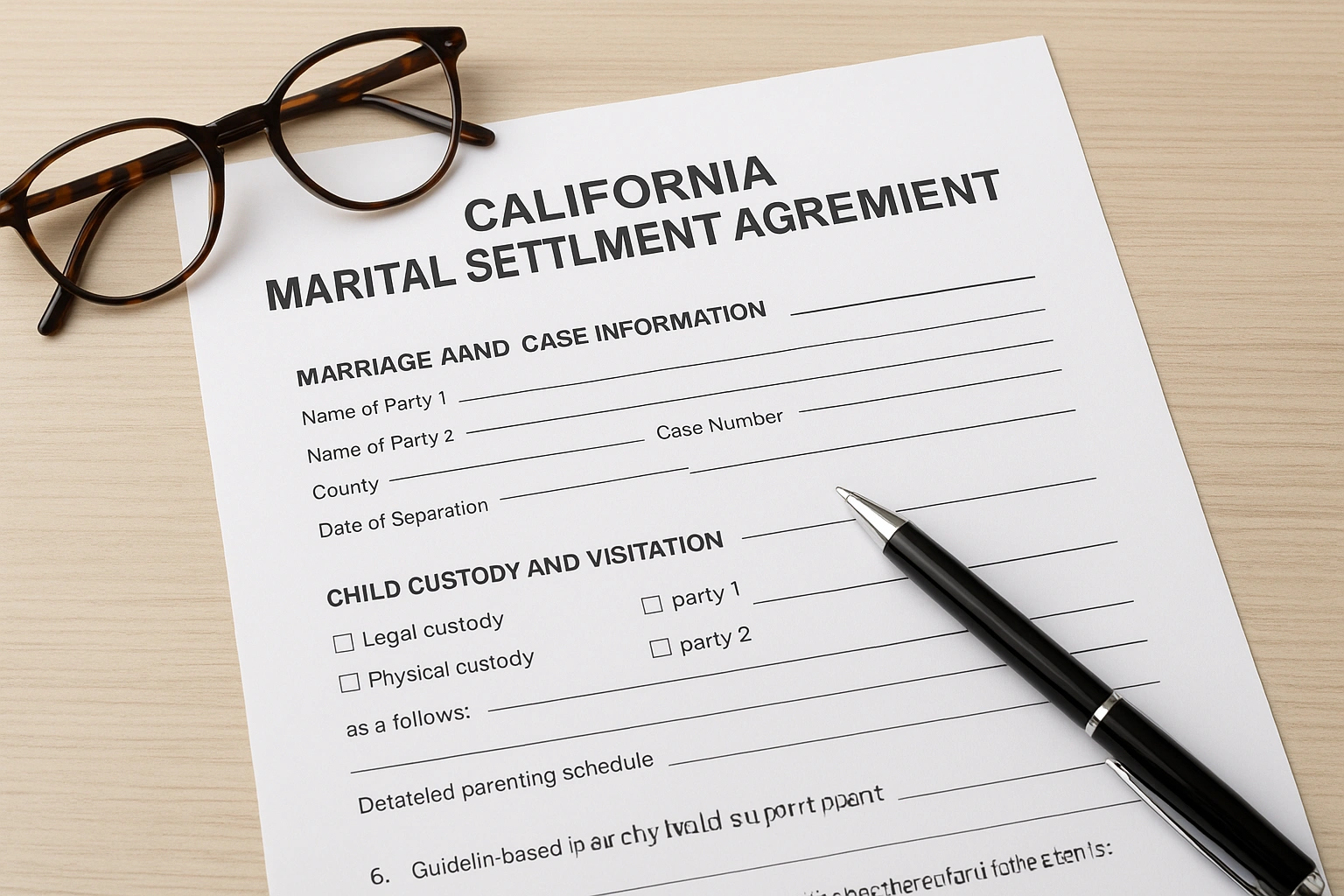
If you and your spouse have agreed on how to split property, handle custody, or divide debts, you still need to get it in writing the right way. A california marital settlement agreement form is the document that turns your agreement into something a judge can actually approve, and getting it wrong can mean rejected paperwork or a return trip to the courthouse.
This guide walks you through the form section by section: what goes in the property division, spousal support, child custody, and debt allocation parts, plus the details courts expect to see before signing off on an uncontested divorce. You'll learn where to find the correct Judicial Council forms, what language holds up in court, and the common mistakes that slow down filing.
We prepare these agreements for California couples every week, so we know exactly where people get stuck, usually on wording for support terms or property descriptions. By the end of this article, you'll know how to fill out your marital settlement agreement correctly, whether you're doing it yourself or want a document preparer to check your work before you file with the court.
What is a California marital settlement agreement?
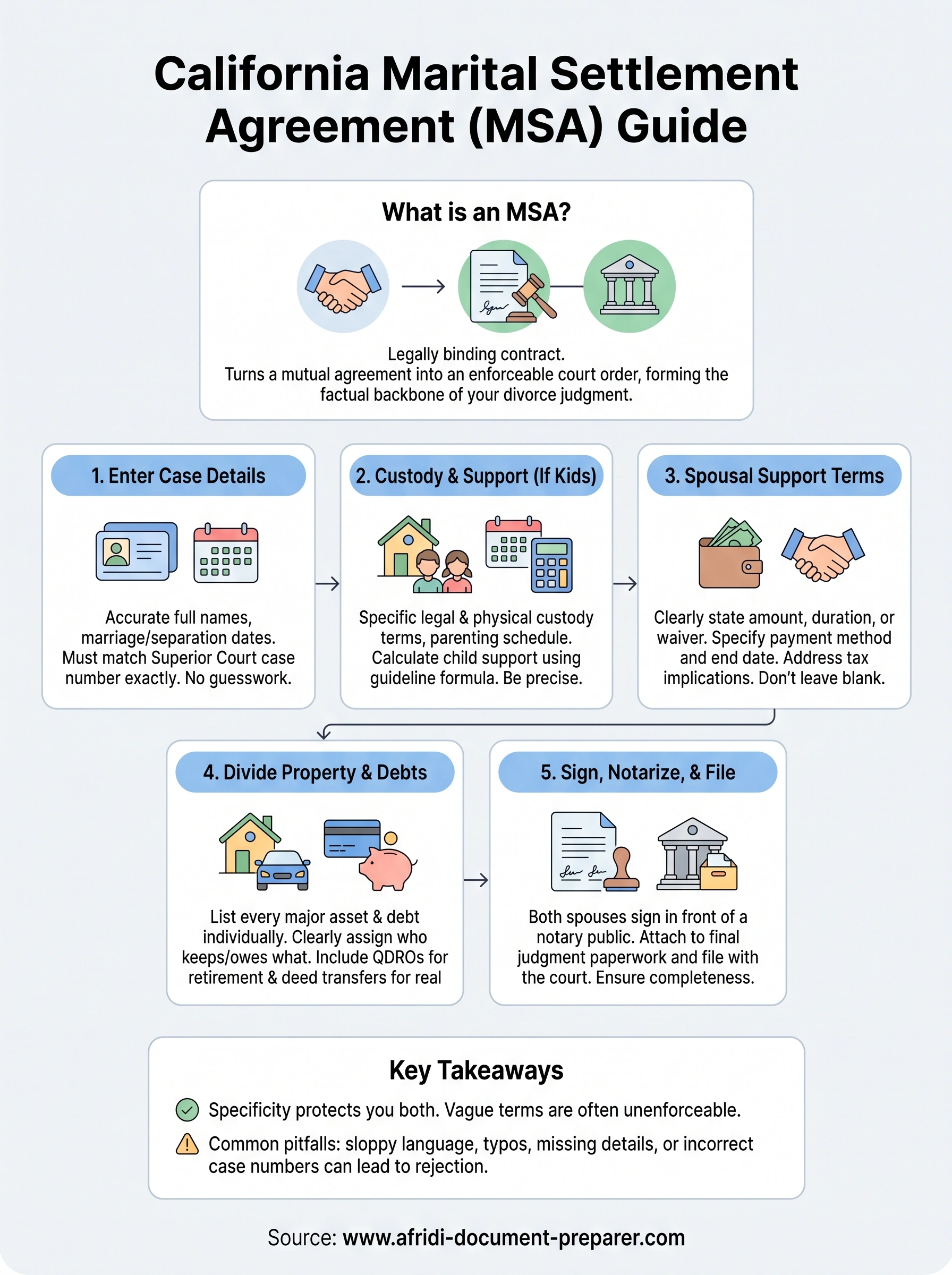
A marital settlement agreement, often shortened to MSA, is a legally binding contract between divorcing spouses that spells out every term of your split: who keeps the house, how you'll split retirement accounts, who pays which debts, and what the custody schedule looks like if you have kids. If you're still sorting out how a marital settlement agreement works in California, start here: California family courts don't grant a divorce based on your verbal agreement or a handshake. They need a signed, notarized document that a judge can review and attach to your final judgment. Without it, your case can't move past the paperwork stage, no matter how amicable the split.
A marital settlement agreement is what turns a mutual understanding into a court order you can actually enforce.
Why courts require this document
Judges in California use your MSA as the factual backbone of your divorce judgment. Once signed and filed, the terms become part of a court order, meaning either spouse can go back to court to enforce them if the other side doesn't follow through, say, missing a support payment or refusing to transfer a car title. This is why sloppy language causes problems. If your agreement says you'll "work out details later" on property division, the court has nothing enforceable to rely on, and clerks routinely reject vague or incomplete filings. Specificity protects you both, even in the friendliest divorces.
What a marital settlement agreement covers
Most California MSAs address the same core categories, though the depth depends on your situation. A childless couple with no real estate might need three pages. A couple with a house, two kids, and retirement accounts might need fifteen.
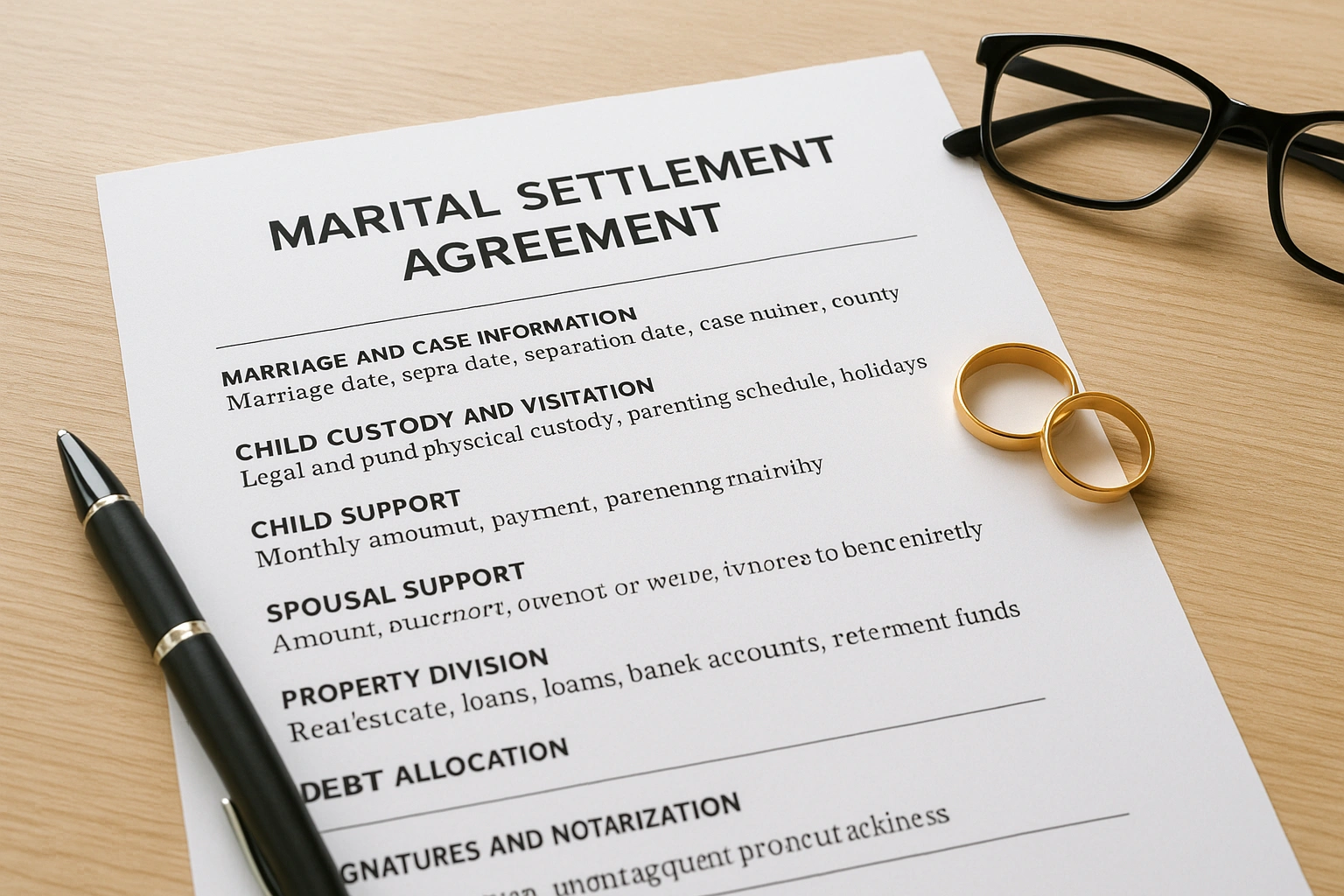
| Section | What it typically includes |
|---|---|
| Marriage and case information | Marriage date, separation date, case number, county |
| Child custody and visitation | Legal and physical custody, parenting schedule, holidays |
| Child support | Monthly amount, payment method, health insurance responsibility |
| Spousal support | Amount, duration, or a waiver of support entirely |
| Property division | Real estate, vehicles, bank accounts, retirement funds |
| Debt allocation | Credit cards, loans, mortgages, and who's responsible |
| Signatures and notarization | Both spouses' signatures, notary acknowledgment |
Each row in that table becomes its own section in the actual document, and we'll walk through how to fill out the major ones step by step below.
When you can use one
Settlement agreements work best for uncontested divorces, meaning you and your spouse already agree on the terms before you sit down to draft anything. If you're still arguing over who gets the dog or how to split a pension, an MSA isn't the tool for that fight yet, you'll need to negotiate first, whether that's through direct conversation, mediation, or attorney-assisted settlement talks. Once you've reached agreement, the MSA documents it in language the court accepts.
One thing to clear up early: a marital settlement agreement is not the same as the divorce petition (FL-100) or the request for a default or uncontested judgment. Those are separate Judicial Council dissolution of marriage forms that start and move your case through the system. The MSA is the private contract that supports those filings, it's typically attached as an exhibit when you submit your final judgment paperwork. Some counties want it filed as a standalone document; others want it incorporated by reference into your judgment. Check with your county clerk before submission, because filing requirements vary even within California's 58 counties. If you'd rather not track down those local rules yourself, our team at Afridi Document Preparer handles the divorce and separation paperwork for clients across the state and knows exactly what each county expects.
Step 1. Enter your marriage and case details
Every marital settlement agreement opens with the identifying information that ties the document to your actual court case. Skip this step or fumble a date, and the clerk can bounce your whole filing back to you, adding weeks to a process that should already be moving. Start by pulling your marriage certificate and any paperwork from the divorce petition (FL-100) that started your case before you fill in a single blank.
Basic identifying information
This top section asks for facts, not opinions, so there's no room for guessing. Gather these details before you start typing:
- Full legal names of both spouses, exactly as they appear on your marriage certificate
- Date of marriage
- Date of separation, meaning the day you and your spouse stopped functioning as a married couple
- County where you're filing
- Superior Court case number, found on your FL-100 or any document the court has already stamped
Getting the separation date right matters more than most people expect. California courts use it to determine which assets and debts count as community property versus separate property, so an off-by-a-few-months guess can shift how much of a retirement account or bonus gets split.
Your separation date isn't a formality, it's the line the court uses to divide everything you own.
Matching your court case number
After the identifying details, confirm your case number matches word for word what's already on file with the Superior Court. Typos here are one of the most common reasons a divorce settlement agreement gets kicked back during review, because the clerk can't match your MSA to an open case. If you filed your petition through an online portal or with the help of a document preparer, double check the number against the confirmation you received rather than relying on memory.
Once this section is accurate, everything else in the agreement inherits that same case identity, which is exactly what the judge needs to attach your MSA to the final judgment. Take the extra five minutes here. It's far cheaper than resubmitting an entire packet because a digit was wrong on page one. With the header details locked in, you're ready to move into the sections that actually shape your day-to-day life after divorce, starting with custody and support if you have children together.
Step 2. Set custody, visitation, and child support terms
Skip ahead to this section only if you have minor children together. Everyone else moves straight to property and debt division. Custody terms need to spell out two separate things: legal custody, meaning who makes decisions about school, healthcare, and religion, and physical custody, meaning where the kids actually sleep on any given night. California recognizes joint and sole arrangements for both, and your MSA needs to state clearly which one you've agreed to for each type.

Vague custody language creates the exact disputes a settlement agreement is supposed to prevent.
Building a parenting schedule
Your agreement should include a written parenting time schedule, not just a general statement that you'll "work it out." Courts want specifics because specifics are enforceable. A workable custody section usually covers:
- Weekly schedule (which days with which parent)
- Holiday and school break rotation
- Transportation and exchange logistics (where, what time, who drives)
- Right of first refusal for extended absences
- How you'll handle schedule changes going forward
If you're preparing the standard Judicial Council forms alongside your MSA, the FL-341 series attachments cover custody and visitation in more granular detail, and your MSA should reference them rather than duplicate every line.
Calculating child support the right way
Child support in California isn't something you and your spouse simply agree on over coffee. The state uses a guideline formula built into software the courts rely on, called DissoMaster or similar programs, which factors in both incomes, custody percentage, tax filing status, and healthcare costs. You can still reach your own number by agreement, but the MSA needs to state whether your figure matches the guideline calculation or deviates from it, and if it deviates, why. Judges scrutinize below-guideline support amounts more closely, especially when kids are involved, because the court's job is protecting the children's interests regardless of what the parents prefer.
Include the monthly dollar amount, the payment date, the method (direct deposit, wage assignment, or through the state disbursement unit), and who carries health insurance for the kids. Address what happens with uninsured medical costs too, most agreements split these according to the same percentage used for support. According to the California Department of Child Support Services, support orders remain modifiable later if circumstances change substantially, so don't worry about locking in a number forever. Get today's arrangement right, and worry about tomorrow's adjustments when they actually arise.
Step 3. Outline your spousal support terms
Spousal support, also called alimony in other states, is one of the sections spouses fight over most, even in otherwise friendly divorces. Your marital settlement agreement needs to state plainly whether one spouse will pay support to the other, and if so, how much alimony is calculated in California, how often, and for how long. Silence on this point isn't neutral. California courts read an MSA that skips spousal support as a waiver, so if you meant to leave the door open for a future request, say so explicitly instead of just leaving the section blank.
Deciding whether support applies
Whether support makes sense depends on the length of your marriage, the income gap between spouses, and each person's ability to become self-supporting, the same factors that shape the difference between spousal support and alimony. Short marriages with two working spouses often skip support entirely. Longer marriages, especially where one spouse left the workforce to raise kids, usually involve some ongoing payment. Your agreement should address:
- Whether support is being paid at all, or mutually waived
- The monthly dollar amount, if applicable
- Payment method and due date
- Whether the amount is modifiable later or fixed
- The termination event, such as a set end date, remarriage, or death
Skipping the spousal support section doesn't leave things open, it usually closes the door for good.
Setting a duration and end date
Duration matters as much as the dollar figure. California generally treats marriages under ten years as short-term, where support often runs for roughly half the length of the marriage, while the ten-year rule for how long spousal support lasts can leave the door open for longer or indefinite support depending on circumstances. Your MSA should name a specific end date or triggering event rather than leaving duration open-ended unless you genuinely intend indefinite support. Vague phrases like "support will continue as needed" give a judge nothing to enforce and invite disputes years down the line.
Making the terms tax-aware and enforceable
Remember that federal tax treatment of spousal support changed under the Tax Cuts and Jobs Act, so payments are no longer deductible for the payer or taxable to the recipient for agreements finalized after 2018. Reference this current treatment in your agreement so both spouses understand their actual take-home numbers, not outdated assumptions from an older friend's divorce. Once support terms are locked in with real numbers and dates, you're ready to move into dividing what you own and owe, which is usually the longest section of the entire agreement.
Step 4. Divide your property and debts
Property division is where most marital settlement agreements run longest, because California is a community property state, meaning most assets and debts acquired during marriage belong equally to both spouses, regardless of whose name is on the title, including property bought while living elsewhere. Your MSA needs to list every significant asset and debt individually, then state clearly who keeps or owes what. Vague language like "we'll split everything evenly" doesn't hold up when a judge or clerk reviews the filing, because there's nothing concrete to enforce if one spouse later disputes an account balance or a car title.

Community property means equal ownership by default, not equal division of every single item.
Listing real property and major assets
Start with real estate, since it's usually the highest-value item in the agreement. Specify the property address, who's keeping it, and how the other spouse's interest gets handled, whether that's a buyout, a sale with proceeds split, or a deferred sale until kids finish school. If a deed transfer is part of your agreement, note that a new deed will be prepared and recorded separately since the MSA itself doesn't transfer title. Our team handles grant deed and quitclaim deed preparation for exactly this situation, since courts want the deed recorded promptly once the judgment finalizes.
Beyond the house, list:
- Vehicles (make, model, who keeps each one)
- Bank and investment accounts, by institution and approximate balance
- Retirement accounts and pensions, noting whether a Qualified Domestic Relations Order (QDRO) is needed to divide them
- Business interests, if either spouse owns or co-owns a business
- Personal property of significant value, like jewelry or collectibles
Assigning debts clearly
Debt allocation follows the same logic as assets. List each debt by creditor and approximate balance, then assign responsibility for payment. Common categories include credit cards, auto loans, medical debt, and the mortgage if one spouse is keeping the home. Address what happens if a joint account still carries both names after the divorce, since creditors don't recognize your MSA, only the original loan agreement. Many couples add a refinance deadline or a hold-harmless clause protecting one spouse if the other misses a payment on a joint debt they're not responsible for anymore.
Once every asset and debt has a name attached to it, read through the section one more time looking for anything left unaddressed. A single forgotten account can reopen negotiations you thought were finished, so thoroughness here saves you real headaches later.
Step 5. Sign, notarize, and file the agreement
Once every section of your marital settlement agreement reflects what you and your spouse actually decided, the document still isn't final until you sign it the right way. California doesn't accept a casual signature on this paperwork. Both spouses need to sign in front of a notary public, and skipping that step is one of the fastest ways to get an entire packet rejected after weeks of waiting for a court date.
A marital settlement agreement without proper notarization is just a draft, no matter how thorough it is.
Getting both signatures notarized
Spouses don't need to sign together in the same room, and plenty of couples handle this separately, especially if one has moved out of state. Each spouse brings a valid photo ID to a notary, signs in the notary's presence, and gets an acknowledgment stamped on the document. Confirm both notary sections are filled out completely, since a missing seal or an expired notary commission can force you to redo the whole signing process. If you're using our team at Afridi Document Preparer, notarization is coordinated as part of the preparation process, so you're not left tracking down a notary on your own.
Filing the agreement with the court
After notarization, the california marital settlement agreement form gets attached to your final judgment paperwork, typically the FL-180 and related forms, rather than filed as a standalone document in most counties. Before you submit, run through this checklist:
- Confirm every blank is filled in, no lingering placeholder text
- Match the case number exactly to your open Superior Court case
- Attach the MSA as an exhibit to your judgment package, per your county's format
- Make copies for both spouses before filing the originals
- Submit through your county's e-filing system or in person, depending on local rules
County clerks vary on formatting expectations, so calling ahead or checking the local court's self-help website saves a wasted trip. Requirements around margins, exhibit labeling, and even paper size occasionally differ between Orange County and, say, Riverside County. Take that extra step to verify before you drive to the courthouse or upload a rejected packet twice.
What happens after your agreement is filed
Once your marital settlement agreement is submitted with your judgment package, the judge reviews it alongside your other paperwork before signing off. If everything is filled in correctly and matches your case file, most uncontested cases move to final judgment without a hearing. Your divorce becomes official on the date the judge signs, though California still enforces the standard six-month waiting period from service before the marriage legally ends.
Getting a california marital settlement agreement form right the first time saves you months of back and forth with the clerk's office. If you'd rather not second-guess your wording on custody, support, or property division, our team at Afridi Document Preparer can review or prepare it for you. Start with a free consultation for uncontested divorce document preparation in California and get your paperwork filed correctly the first time.
Disclosure: The information provided in this article is for general informational purposes only and does not constitute legal advice. The author is not a licensed attorney. The content should not be construed as professional legal advice or a substitute for professional legal counsel. No attorney-client relationship is formed by reading or interacting with this article. The information presented may not reflect the most current legal developments, and laws and regulations can vary by jurisdiction and may change over time. Readers should not act or refrain from acting based on the information in this article without first seeking appropriate legal or other professional advice. Always consult a qualified attorney for advice regarding your specific legal matter or circumstances. The author expressly disclaims all liability in respect of actions taken or not taken based on any or all of the contents of this article.
